


on how we can be close to the karmapa: what it means to be kagyu

The recent events surrounding His Holiness Orgyen Trinley Dorje have been extremely painful to watch. I realize that I am not the only person who has strong feelings about the present situation. Right now it feels important to bring these feelings inward and let those who are much more skillful and experienced with the complexities of these issues remain at the forefront. Perhaps directing all of the emotions that arise from the present situation towards practice, and using this present moment to reflect upon the Kagyu lineage can be a powerful tool for connection and empowerment. Rather than add to the frenzy of internet activity through discussing what has been going on, I would like to respectfully let the Office of His Holiness the 17th Gyalwang Karmapa with its advisors lead the way, they are wise, capable and have my complete confidence.

So let’s go deeper. What does it mean to be Kagyupa?
Practice. Devotion. These qualities are certainly not solely owned by the Kagyu lineage, or even vajrayana buddhism for that matter, but they are the special signature of this precious ear-whispered lineage.
What does that mean?
The relationship that the great Pandit Naropa had with his radical, skillful and essential guru Tilopa was one of great intimacy and tenderness. It was a relationship of sharing, where a master tested and took great care in exhausting the neuroses and misapprehensions of his student, who through his own dedication and drive, applied the special instructions and worked hard to guard and tend to the experience of enlightenment. Master and student lived side by side so that any ordinary experience could be used as a tool for revealing the dharma. In creating the a relationship of close intimacy Tilopa challenged Naropa, he knew what buttons to push, he chided Naropa’s intellectualism, and ultimately empowered him to experience buddhahood.
Marpa the indomitable angry Tibetan farmer- stuborn and hard-headed- decided to leave Drogmi Lotsawa to find and experience dharma on his own, for himself. Undergoing a series of journeys through out Nepal and India he eventually found his guru, Naropa. Marpa had to bear the brunt of being Tibetan in 11th century India, not an easy task Tibetans were generally regarded as rough and not that intelligent by their Nepali and Indian contemporaries. Indeed, the mahasiddha Sri Santibhadra (aka Kukkuripa) to whom Marpa was directed to initially receive the transmission of the Mahamaya Tantra asked why he should give the empowerment of the Mahamaya Tantra and subsequent explanations to a “stupid flat nosed Tibetan?” That must have really pushed the buttons of this precocious, driven seeker who was known for having a short fuse! The relationship between Naro and Marpa, like that of Tilopa and Naropa, was also intimate and close- Marpa spent years actualizing the paths that were offered to him from his primary guru, Naropa. Marpa also maintained close relationships with the mahasiddhas Maitripa, Kukkuripa, as well as Saraha (in the dream-state). Marpa brought the instructions of these great masters back to Tibet and firmly placed the victory banner of the kagyu ear-whispered lineage upon the Tibetan Plateau.

Milarepa, the repentant magician suffered great loss early on in his life. Imagine the loss of everything you know as one of your parents die, imagine that all you have every owned, or all that has ever been promised to you has been taken by family that you trusted. Imagine the shame and guilt, the remorse and regret that Milarepa must have felt growing up- imagine those feelings distilling into the deep focus to harm others. Marpa, the farmer lama, with his liberating presence, took the time to be there for Milarepa as a teacher in the best way possible. He had the skill to know that forcing Milarepa to perform nearly impossible tasks of physical labor to ripen his karma, to help push the reset button, and to reveal wholeness where previously there was just suffering, was appropriate. After all, Milarepa had been to a teacher before Marpa who was much looser in his teaching style which didn’t fit with Milarepa’s attitude. As a result not much occurred between Milarepa and this other teacher. Marpa, ever the farmer, planted the seeds of dharma within Mila’s being and carefully, tenderly raked, weeded and fed these seeds until the grew into a rich crop.
Rechungpa and Gampopa, the left and right hands of Mila Laughing Vajra, expressed the wisdom, instruction and blessings of their father-like lama. Gampopa did this through codifying and merging the ear-whispered lineage of experience with his experience as a Kadampa monk thus providing a monastic base for the Kagyu lineage; his famous Jewel Ornament of Liberation is a classic lamrim (stages of the path) presentation of the dharma. Rechungpa, a repa or cotten-clad yogi, continued more within the activity tradition of Marpa Lotsawa, returning to India to procure the empowerments and instruction for the practice of the Formless Dakini, a lineage that is still maintained within the Drikung Kagyu lineage. Both Rechungpa and Jey Gampopa were cared for by Milarepa- they had very close and different relationships with Milarepa. The devotion and sadness that Rechungpa expressed upon learning of Milarepa’s death is a beautiful reminder of the internal connection that they had. It also feels important to note that the last thing that Milarepa shared with Gampopa was showing him his calloused buttocks- a final testament that practice is essential, that the experience of liberation is supported by practice.

The Kagyu lineage, and all of its branches, is often refered to as a practice lineage. And indeed, if one took a look at the lives of the lineage holders, one can see that great care has always been applied to the maintainance of the purity of the lineage, as well as experiencing or tasting its essential essence. When we look at the lineage of the Karmapas, Tai Situpas, the Gyaltsabpas, the lineage of Jamgon Kongtrul Rinpoche, Traleg Rinpoche, Thrangu Rinpoche, Tenga Rinpoche, Sangye Nyepa Rinpoche, Trungpa Rinpoche, Kalu Rinpoche, Bokar Rinpoche, Mingyur Rinpoche, Chokgyur Lingpa, Karma Chagme Rinpoche, Khamtrul Rinpoche, and many other great Rinpoches, and unknown practitioners, it is amazing how alive and energetic the Kagyu lineage is.
I sometimes feel that people believe that being Buddhist involves shunning the world and keeping ourself calm and without emotion. In the hospital I am often asked by patients how I have the strength to not feel or to remove myself from the world. I don’t have that strength, I’m not even sure if that is a strength, and even if I did, I wouldn’t want to remove myself from the world. There are worlds upon worlds within us, physical isolation or separateness alone doesn’t change that. The freedom we seek is found in embracing what is right infront of us. Buddhism is in the midst of being translated to the western idiom. It has firmly taken root in many respects, however I feel that a significant point of focus may need to be how we as Buddhists (perhaps more so for vajrayana Buddhists, although maybe not) can maintain sacred-outlook as well as a realistic understanding of the world around ourselves. How can we connect to the visionary nature of our lineages, create real connection, feel that we are part of them, recieve the blessings of their transmission history without having an overly utopian notion of how everything constellates with the world that we live in?
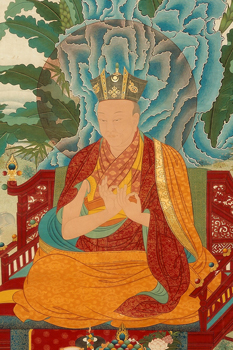
A few years ago I read a translation of a text by Raga Asay, the first Karma Chagme Rinpoche in which a story was related about Raga Asay who after recieving instruction from the 10th Karmapa Choying Dorje, prefered to live far away from Tsurphu. When asked by a friend why he would choose to live far away and not be able to attend public events (empowerments, reading transmissions, teachings, etc.) Raga Asay replied,” when I am in retreat the lama on the top of his head is near and I always feel his blessings. When I am at Tsurphu my mind is plagued by insecurity, jealousy and gossip.” Karma Chagme found the balance; his balance, a confidence in his relationship with His Holiness as well as with the larger lineage. At the same time Karma Chagme seems to be suggesting “people are people are people”- we gossip, brag, and in all our enthusiasm during special religious functions often inadvertantly act unskillfully.
In terms of the present situation, it is easy to pick up on and focus on the politics, the gossip, and the intrigue and forget that this is all appearance. By all means we should support His Holiness, but as his children perhaps we should bring what arises within us to the path. This is what Gampopa refers to when he lists the ways to deal with obstacles to practice, we can try to abandon obstacles, or we can transform them, or we can rest within them as they arise. Gampopa suggests that transforming obstacles is good, but that resting in them may be better- it is a way to bring direct experience of the present moment to our practice. In facing our fears, our insecurities, our rage, our frustration, and being able to be aware of this as none other than the play of our mind, we are able to be clear and free.
When His Holiness came to Mirik to consecrate and install the kudung stupa of Kyabje Bokar Rinpoche, His Holiness told the large group of Kyabje Bokar Rinpoche’s students that our greatest offering to Bokar Rinpoche is our practice. That to put into practice his instructions, and to aspire to completely master master them, we are connecting in a profound manner to Kaybje Bokar Rinpoche. This sounds like timely advice for the present moment, but also something to keep in mind at all moments. While we can not always serve our lama in an everyday setting, we can serve our lama by holding dear and practicing the instructions that she or he offers us.
The office of His Holiness recently offered a statement of thanks to everyone who has supported His Holiness and his labrang and suggested that we offer our practice towards the removal of all obstacles towards the problems that His Holiness has faced. You can read it here. This is wonderful! I cannot think of a better way to maintain a connection with such an amazing teacher. In practicing for him, we are generously offering our time, our effort, our spirituality as well as our connection with the lineage from which the instructions that we follow flowed from. This is an offering beyond time and space; an essence offering which when fused with the intention of benefiting His Holiness and his labrang- doubtless, this is a powerful way of maintaining connection, it’s a way through which we can feel the heartbeat of Tilo, Naro, Marpa, Mila within our very being.
Although all practitioners have a lineage,
If one has the Dakini lineage, one has everything.
Although all practitioners have a grandfather,
If one has Tilo, one has everything.
Although practitioners have a lama,
If one has Naro, one has everything.
Although practitioners have teachings,
If one has the hearing lineage, one has everything.
All attain the Buddha through meditation,
But if one attains Buddhahood without meditation,
There is definite enlightenment.
There is no amazing achievement without practice,
But there is amazing achievement without practice.
By searching, all will find enlightenment,
But to find without searching is the greatest find.
-Marpa

ordinary everyday teachers

The other day I posted about the importance of the spiritual teacher in a general kind of way. The three texts that I drew from, by the Third Karmapa, Rangjung Dorje, Milarepa, and Gampopa respectively, all highlight different approaches to how we benefit from out teachers. These are our ‘ecstatic’ or extraordinary teachers. What I would like to focus on today are the ordinary teachers, our everyday teachers.
Recently I met a patient in the hospital where I’m doing my clinical chaplaincy training. He had undergone extensive surgery several months ago to remove cancerous tissue that was spreading throughout his abdomen. He had also received radiation to help destroy any last bit of the cancer. He was young, only forty years old, and had only recently had the chance to experience life outside of the hospital. His cancer had gone into remission, he went home for the holidays and spent them with friends and family. All of the sudden, quite recently, he had begun to feel pain in his abdomen and went to his doctor to have it checked out. His doctor suggested that he come into the hospital for some tests. This is where I met him. He was laying in bed, his mother sitting by his side expectantly. As we started talking he described all of the tests that had just been done on a variety of his organs all of which presented the possibility of cancer. He was thin and animated despite being hooked up to a morphine drip to control his pain. As our conversation continued he started to cry and describe how angry he was with god about his present situation. As we spoke I asked him how not knowing, how the uncertainty of his present situation made him feel, and this lead to his anger with god or whatever force put him in his present situation. I asked him if he could share with me all the ways in which he was pissed off, to which he offered a lengthy, articulate and powerful list of feelings that lead to his anger. One of the feelings that he described involved his relative youth and what the reason for his being on earth actually was. He was afraid that he would never truly help others, that his desire to be a positive force for change in the world would be cut short by his illness. I was struck by his openness and the kindness with which he shared his fears, his pains, and also his joys, his hopes as well as his dreams. I felt so included by him in his life and in his story that I told him that I found him to be a graceful, compassionate and caring teacher- someone who I will never forget, who has touched me with gentle simplicity. I also mentioned that his mother may feel similarly, at which she started to cry as she said, “Yes, yes, he is wonderful.”
This patient has become a profound teacher for me. Part of his impact may have come from his circumstances, his illness and vulnerability, as well as his clarity and honesty with which he could share his feelings with me; but I tend to feel that we connected. His heart was open towards me, and mine towards him: we entered into relationship. It was meaningful for both of us. Towards the end of our meeting we seemed connected and full, we gave to, and supported one another.

There are an estimated 6,897,395,150 people on Earth, and the person who I just described above is just one of them. How amazing it is that we feel transformed in connecting with just one person, and yet there are so many others that we don’t or can’t open up to. I find this very humbling. Perhaps this is what an open heart truly is.
I am reminded of a portion of a text on mahamudra that was composed by Kyabje Bokar Rinpoche; it was his distillation of a much larger text by the ninth Karmapa, Wangchuk Dorje, entitled the Ocean of Certainty. In his text (Opening the Door to Certainty) Bokar Rinpoche describes the different types of lamas, or teachers. These are, the lama as a human being belonging to a lineage, the lama as awakened word, the lama as appearance, and the lama as ultimate nature. The lama of appearance is described as appearance as teacher; that all that we see, hear, touch taste, and smell, all of our thoughts are all our teachers. How do we react to them? What do they cause to arise in us? There is a beautiful simplicity in appearance as teacher; it is loose and freeing; it allows us to go out and interact with the world around us; it allows us to enter into relationship with everything around us. This is wonderfully special. We are constantly surrounded by countless ordinary, everyday teachers, all of whom offer us the possibility of connection and growth.
on the importance of the teacher
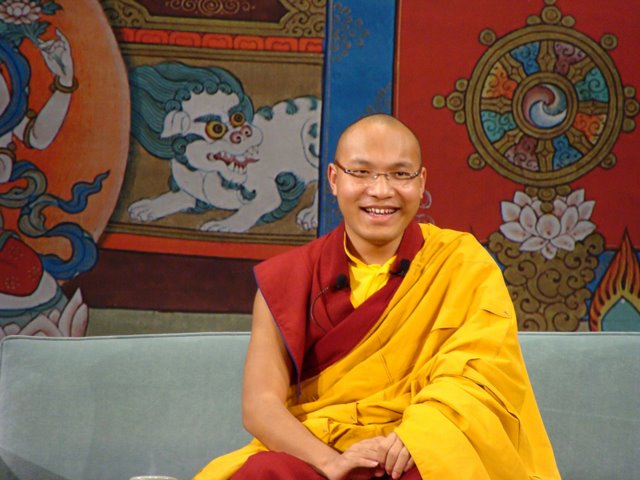
I recently spent time considering the importance of my teachers and how fortunate I feel to have received just a portion of the stream of their experience through instruction. The importance of the teacher, whether we call him or her lama or guru, is central- for where would we be without their guidance, their compassion, and their wisdom? Through the openness that we allow ourselves to have with our teachers, a connection of transmission occurs through which we can experience our own fullness and Buddha potential, just as they themselves have done.
I’ve found three passages that help illustrate this point:
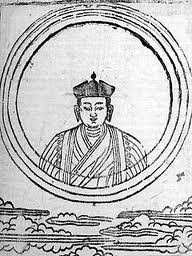
This first one is entitled Hail to Manjushri, it was written by the third Karmapa Rangjung Dorje (1284-1339).
Hail to Manjushri!
All phenomena are like illusions,
though absent they appear to exist;
wise indeed are those who cognize them
within the ever-present unborn.
If you perceive the glorious guru
as a supremely enlightened being,
indivisible from your own mind,
you will receive blessings and strength.
If you, without ceasing, propel the flow
of channels, wind energies, and vital drops-
the nexus of interdependent factors-
the stains of self-love will be swiftly cleansed.
The manifold states of nonconception-
clarity and bliss- I place on the path
of nonapprehension, like patterns in water,
then the true mode of being will be definitely seen.[i]

This next song is from the larger section of the collected songs of Milarepa (1052-1135). Milarepa, one of the greatest yogins tha Tibet saw was the heart student of Marpa Lotsawa. Milarepa’s endurance in his practice, and the joy with which he taught is truly remarkable. This song is a portion of the larger song-story called The Song of a Yogi’s Joy:
The Guru, the disciple, and the secret teachings;
Endurance, perseverance, and the faith;
Wisdom, compassion, and the human form;
All these are ever guides upon the Path.
Solitude with no commotion and disturbance
Is the guide protecting meditation.
The accomplished Guru, the Jetsun,
Is the guide dispelling ignorance and darkness.
Faith without sorrow and weariness
Is the guide which leads you safely to happiness.
The sensations of the five organs
Are the guides which lead you to freedom from “contact.”
The verbal teachings of the Lineage Gurus
Are the guides which illustrate the Three Bodies of the Buddha.
The protectors, the Three Precious Ones,
Are the guides with no faults or mistakes.
Led by these six guides,
One will reach the happy plane of Yoga-
Abiding in the realm of Non-differentiation
In which all views and sophisms are no more.
Remaining in the realm of self-knowledge and self-liberation
Is indeed happy and joyful;
Abiding in the valley where no men dwell,
With confidence and knowledge, one lives in his own way.
With a thundering voice,
He sings the happy song of Yoga.
Falling in the Ten Directions is the rain of fame;
Brought to blooming are the flowers and leaves of Compassion.
The enterprise of Bodhi encompasses the Universe;
The pure fruit of the Bodhi-Heart thus attains perfection.[ii]

The third passage is from Gampopa (1070-1153), one of the two main students of Milarepa, and the first to combine the ear-whispered teachings of Milarepa with the Kadampa monastic tradition, thus institutionalizing the Kagyu lineage as a generally monastic lineage. This passage comes from Gampopa’s Precious Garland of the Supreme Path, a wonderful instruction manual of practical advice from this special master. What follows is his description of the first thing that one should rely on as we tread the path, from the third portion of the text entitled, Ten Things Upon Which To Rely:
The first thing on which we must rely is a holy guru who possesses both realization and compassion. The lama must possess realization because a teacher who has no realization or actual experience is like a painting of water, which cannot quench our thirst, or a painting of fire, which cannot warm us. As well, a lama must possess compassion. If the lama merely has realization but has no compassion, he or she cannot teach and will not help sentient beings develop virtuous qualities and relinquish defects. Thus the first thing ton which we must rely is a lama who possesses both realization and compassion.[iii]

I hope that these passages contribute to a sense of connection and warmth with our teachers, and I hope that this connection helps foster inspiration. May this inspiration translate into diligent practice, and through this practice may we fully realize the essence of our teachers’ instructions. May we develop the same stainless conduct as our teachers! May we too raise the victory banner in the citadel of enlightenment!
May the activities of his Holiness the 17th Karmapa flourish and may all obstacles naturally dissolve into emptiness. May his life be long, and may the compassionate wisdom of his example be known to all beings!
[i] Jinpa, Thubten and Elsner, Jas, trans. Songs of Spiritual Experience. Shambala Publications, 2000. Pg. 157.
[ii] Chang, Garma CC.trans. The HUndered Thousand Songs of Milarepa. Shambala Publications,1999. Pg. 80-81.
[iii] Khenpo Karthar Rinpoche. The Instructions of Gampopa. Snow Lion, 1996. Pg. 22.
His Holiness Karmapa on the Kagyu Monlam
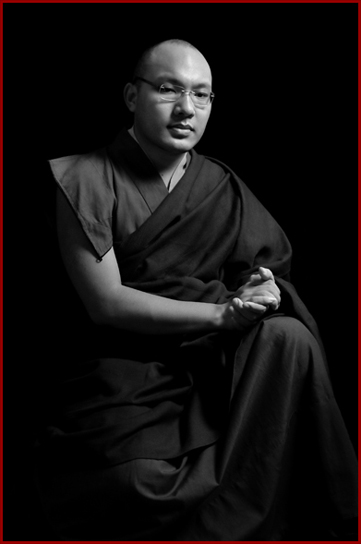
Composed by His Holiness the Seventeenth Karmapa, Ogyen Trinley Dorje
like nectar flowing from a spring on a snowy mountain face,
from some highest of realms high above,
with effortless vigor and a deep, unprompted longing,
drop after divine drop, each pristine and pure,
you crossed the mountains and plains of hundreds of months and years,
to come cascading down, down into the land of our hopes.
coursing through deep aspirations you held, held through the stream of many lives,
from some place completely obscured to us, you gave gentle warmth and nourished us.
since then, the tender young sprouts of virtuous minds
have blossomed with leaves and fruit,
and land once scorched with drought burst into life turquoise-green.
when a snow lion roars on a white mountain peak
the sound at once sends the crisp flakes swirling in a flurry.
when you arrived in the year eleven-ten
the lion’s roar of your majestic name blazed forth,
spreading its unchanging splendor and unequalled blessings.
day and night, for nine hundred years,
it has set trembling the hearts of those with faith, scared away the sleep of our ignorance
and stilled the waves of thought that trouble the ocean of our minds.
with the fearful crash of its sound, the haughty become hushed and still.
because you are here, we dare to face the angry countenance of the samsaric sea.
because you are here, we know that there is an end to this suffering.
the world, its voice raised in cries of birth and death, falls silent.
your deeds blend completely with a sky as deep blue as your brilliant crown.
your great heart, like a splendid mandala of wind,
keeps this world ever moved.
O Karmapa, you who act,
I am all that you have. and you are all that I have.
A feast song by the 3rd Karmapa Rangjung Dorje
As the Kagyu monlam begins I would like to share a feast song, a ganachakra celebration, composed by the third Karmapa Rangjung Dorje.

With the monlam and all of its blessings in mind, I offer this song. May the Kagyu monlam benefit all beings, and may the activities of His Holiness the 17th Karmapa Orgyen Trinley Dorje be vast!
A Feast Song in Lhasa
I salute the guru Jewel.
In the ocean of true essence
arise multitudes of unreal concepts,
like varied patterns in the water.
Therefore I practice the following.
This heroic feast- the culmination of merit
for the profound mother tantra-
was taught to increase the merit of beings.
Thus do I understand its meaning:
Beings of the beginning stage
should visualize their body as a deity
at this stage of imaginative engagement.
Purify food and drink into nectar,
and offer the skandhas to the victorious sages.
This is called the great feast:
heros and heroines equal in number,
who have attained high realizations,
contemplate the essence of void and bliss
amid the abundance of food and drink.
Great is the assembly at the feast!
Since all heros have gathered,
it is called the joyous feast of heros.
The Master knows the way of mantra,
his mindstream is empowered,
he understands the essential precepts;
disciple-hosts of heroines and heros,
together engage in full absorption-
the stages of generation and completion-
immeasurable are the attainments of the feast.
Those who do not possess such virtues,
and wrongly take out of self-importance,
will encounter obstacles; this is foretold.
Though I have not seen the assembled heros,
I have sung the essence of the tantric scriptures;
for this is called the essential instruction.
Be inspired with wondrous admiration.
Join the celebration, partake fully in the feast!
(This poem was sung in Lhasa at the assembly gathered to celebrate a religious feast on the evening of the eighth day of the tenth month of the dragon year)[i]
[i] Taken from Songs of Spiritual Experience, trans. By Thupten Jinpa and Jas Elsner. Shambala, 2000.

Kalu Rinpoche and Bokar Rinpoche, Father and Son, protectors of the Kagyu Monlam.
It has always felt to me that if Kyabje Kalu Rinpoche was the essence of Milarepa, then Kaybje Bokar Rinpoche was the essence of Gampopa. While I never had the chance to meet Kalu Rinpoche, I have met many Tibetan, American, British and French students of Rinpoche who often spoke of his direct orientation towards practice, his passion for transmitting instruction, and his easy going trust in the dharma- these seem to be qualities that I associate with Milarepa.


Similarly, Bokar Rinpoche with his purity of heart, emphasis upon transmission of the lineage teachings and stainless vinaya, truly does remind me of qualities that were emblematic of Je Gampopa. In expressing the direct simplicity of mind, Kyabje Bokar Rinpoche was known as a great master of Mahamudra.
That they both maintained, preserved and expanded the Kagyu Monlam in Bodh Gaya is important. Kyabje Kalu Rinpoche can be credited with establishing the Kagyu monlam in Bodh Gaya. When he began the monlam it was a small informal gathering. After his passing, Kyabje Bokar Rinpoche continued the practice of maintaining and further developing the Kagyu monlam; it slowly grew and grew. I attended several of these earlier monlams where Bokar Rinpoche and Yangsi Kalu Rinpoche presided over a much smaller number of monks, nuns and lamas than those that attend present monlam celebrations. They were a combination of grand and intimate, which seemed just right for reciting aspiration prayers and receiving inspiration.
After His Holiness the 17th Karmapa escaped from Tibet in January of 2000 and was allowed to travel inside of India, he presided over the monlam. Its as if Kyabje Kalu Rinpoche and Kyabje Bokar Rinpoche were keeping his Holiness’ seat warm under the bodhi tree. Since the sudden death of Kyabje Bokar Rinpoche, the monlam has been run by Lama Chodrak (the lama he appointed to organize the monlam) and the monlam committee. His Holiness the 17th Karmapa has also taken a strong role in monlam planing, and feels strongly about its mission and goals.
With their activities in mind I offer this song of supplication written by Kaybje Bokar Rinpoche. May it be of benefit!!

Wide Wings That Lift Us to Devotion: A supplication
A Vajra song by Kyabje Bokar Rinpoche
Spiritual master, think of me! Think of me!
Source of all blessings, root spiritual master, think of me!
Spiritual Master, think of me! Think of me!
Epitome of all accomplishment, root spiritual master, think of me!
Spiritual master, think of me! Think of me!
Agent of all enlightened activity, root spiritual master, think of me!
Spiritual master, think of me! Think of me!
All refuges in one, root spiritual master, think of me!
Turn all beings’ minds, with mine, towards the Teachings.
Bless me that all stages of the faultless path-
Renunciation, the mind of awakening, and the correct view-
Genuinely arise in my being.
May I dwell untouched by the faults of pride and wrong views
Toward the Teachings and the teacher of freedom’s sublime path.
May steadfast faith, devotion and pure vision
Lead me to fully achieve the two goals for others and myself.
The Human tantric master introduces my intrinsic essence.
The master in the Joyful Buddha’s Canon instills certainty.
The symbolic master in appearances enriches experience.
The ultimate master, the nature of reality, sparks realization of the abiding nature.
Finally, within the state of the master inseparable from my own mind,
All phenomena of existence and transcendence dissolve into the nature of reality’s expanse;
The one who affirmed, denied and clung to things as real vanishes into the absolute expanse-
May I then fully realize the effortless body of ultimate enlightenment!
In all my lifetimes, may I never be separate from the true spiritual master.
May I enjoy the Teachings’ glorious wealth,
Completely achieve the paths and stages’ noble qualities,
And swiftly reach the state of Buddha Vajra Bearer.
In 1995, in response to requests from two translators, Lama Tcheucky and Lama Namgyal, on behalf of my foreign disciples, I, Karma Ngedon Chokyi Lodro, who holds the title of Bokar Tulku, wrote this at my home in Mirik Monastery. May it prove meaningful.[i]
[i] Zangpo, Ngawang. trans. Timeless Rapture: Inspired Verse of the Shangpa Masters. Snow Lion Publications. 2003. Ithaca, NY., Pg. 215-217.
his holiness the 16th karmapa on the nature of mind
In honor of the approaching 28th annual Kagyu monlam in Bodh Gaya I would like to share a pith instruction of His Holiness the 19th Karmapa Rangjung Rikpai Dorje. While every year is special, and every Kagyu monlam is truly a wonderous event, this year’s monlam coincides with the 900 year anniversary of the birth of the first Karmapa, Dusum Khyenpa. This is a moment to celebrate and praise the history of the Kamstang Kagyu Lineage and all of its wonderous lineage holders, siddhas, yogins and yoginis. Emaho! I am humbled to know that His Holiness the 17th Karmapa, Orgyen Drodul Trinley Dorje will be leading the prayers along with the leading lineage holders of the Kagyu lineage.
You can learn more about this year’s monlam, its schedule and special activities here.

His Holiness the 16th Karmapa on pointing out the nature of mind
Here, in the thick darkness of deluded ignorance,
There shines a vajra chain of awareness, self-arisen with whatever appears.
Within uncontrived vividness, unimpeded through the three times,
May we arrive at the capital of nondual, great bliss.
Think of me, think of me; guru dharmakaya think of me.
In the center of the budding flower in my heart
Glows the self-light of dharmakaya, free of transference and change,
that I have never been separate from.
This is the unfabricated wisdom of clarity-emptiness, the three kayas free of discursiveness.
This is the true heart, the essence, of the dharmakaya, equality.
Through relying on the display of the unfabricated, unceasing, unborn, self-radiance,
May we arrive at the far shore of samsara and nirvana- the great, spontaneous presence.
May we enter the forest of the three solitudes, the capital of the forebears of the practice lineage.
May we seize the fortress of golden rosary of the Kagyu.
O what pleasure, what joy my vajra siblings!
Let us make offerings to dharmakaya, the great equal taste.
Let us go to the great dharmadhatu, alpha purity free from fixation.
They have thoroughly pacified the ocean of millions of thoughts.
They do not move from the extreme-free ocean of basic space.
They posses the forms that perfect all the pure realms into one-
May the auspiciousness of the ocean of the protectors of being be present.
In the second month of the Wood Hare year (1976), [His Holiness] spoke these verses at Rumtek Monastery, the seat of the Karmapa, during the ground breaking ceremony for the construction of the Dharmachakra Center for Practice and Study.
New York Zen Center for Contemplative Care on TV!
This weekend a segment of the television show Religion and News Ethics Weekly will broadcast a taste of the New York Zen Center for Contemplative Care chaplaincy training program on PBS which you can also watch here. NYZCCC is a rich and rigorous CPE training program that is truly unique. I am constantly challenged by the depth of the curriculum as well as that of the instructors, Koshin Paley Ellison, Robert Chodo Campbell, and Trudi Jinpu Hirsch. Currently I am half way through my first of two units of CPE through NYZCCC’s year long extended unit program, was a participant in their Foundations in Contemplative Care program last year, and look forward to more training with them in the future. I can’t say enough wonderful things about the program and how wonderfully rare it is.
I invite you too to explore NYZCCC here…
Milarepa on the nature of mind
This is a particularly intimate and moving song of instruction by Milarepa for his student Gampopa. The imagery of a parent concerned for his child contributes to the sense of closeness between the teacher and student in this song, it also shows how subtle some of the maras (perceptual delusions) that we experience along the way can be. Milarepa as the tender father helps to point out some of the pitfalls that obscure the natural luminosity of the mind’s essential nature.
Following along with the parenting metaphor for a moment, I am reminded of a teacher who once reminded a friend and I that once one begins to meditate, no matter how much time spent in meditation, or its frequency, we should act as if we are pregnant; or we should know that we are pregnant with the innumerable qualities and benefits of Buddhahood. How long the gestation period will be is hard to know, but one day we will give birth to the clear and stainless realization of our mind. All it takes is to begin a meditation practice and examine what effects it has on our perception and our relative well-being; once we are pregnant with this potential awakening, we should guard ourselves against that which complicates and distracts our meditation practice. The tone that Milarepa sets in this song is gentle and supportive; how can we be this way with ourselves in our practice?

A Song of Instruction to Gampopa
By Milarepa
Son, when simplicity dawns in the mind,
Do not follow after conventional terms.
There’s a danger you’ll get trapped in the eight Dharma’s circle.
Rest in a state free of pride.
Do you understand this, Teacher from Central Tibet?
Do you understand this, Takpo Lhajey?
When self-liberation dawns from within,
Do not engage in the reasonings of logic.
There’s a danger you’ll just waste your energy.
Son, rest free of thoughts.
Do you understand this, Teacher from Central Tibet?
Do you understand this, Takpo Lhajey?
When you realize your own mind is emptiness,
Do not engage in the reasoning “beyond one or many”.
There is a danger that you’ll fall into a nihilistic emptiness.
Do you understand this, Teacher from Central Tibet?
Do you understand this, Takpo Lhajey?
When immersed in Mahamudra meditaion,
Do not exert yourself in virtuous acts of body and speech.
There’s a danger the wisdom of nonthought will disappear.
Son, rest uncontrived and loose.
Do you understand this, Teacher from Central Tibet?
Do you understand this, Takpo Lhajey?
When the signs foretold by the scriptures arise,
Do not boast with joy or cling to them.
There’s a danger you’ll get the prophecy of maras instead.
Rest free of clinging.
Do you understand this, Teacher from Central Tibet?
Do you understand this, Takpo Lhajey?
When you gain resolution regarding your mind,
Do not yearn for the higher cognitive powers.
There’s a danger you’ll be carried away by the mara of pretentiousness.
Son, rest free of fear and hope.
Do you understand this, Teacher from Central Tibet?
Do you understand this, Takpo Lhajey?[i]
[i] Songs and Instructions of the Karmapas. Nalandabodhi Publications. 2006. Pg. 25-26.
Pointing out the Self with the Iron Hook of Mind
In the first post for Ganachakra I wrote a partial introduction to the late Kyabje Pathing Rinpoche. I would like to return to Pathing Rinpoche, to share a teaching song he composed and shared with my dharma brother Erik Bloom and I.

If I had to be stranded on a deserted isle with one set of instructions, just one teaching, I would choose this one. The title alone sets the tone, it is strong and direct. Pathing Rinpoche is clear in his description of the view, the path (of cultivating the view), and the fruition (of familiarizing oneself with the view; how to blend it with your being). The tantric imagery is rich and beautiful. This is a truly precious a wonderful teaching. If you have a moment, take a second to clear your mind, settle down, and have a read. I’d love to hear what you feel after reading it.

Instructions on Pointing Out the Faults of Self with the Iron Hook of Mind
In general, everything in the universe, outer, inner and secret, I offer to satisfy and benefit the six classes of beings.
The whole field of accumulation, the three Jewels as well as the three kayas, the entire universe I offer to the inner and secret deities, may they be satisfied.
To the Male and female yogis and yoginis I offer vajra food and vajra water, may they be satisfied.
Primordial Awareness, the mandala of pure amrita, I offer so that those in the lower realms may be satisfied.
The body mandala deities who are the union of bliss and emptiness, who are primordial awareness, may they be satisfied.
Everyone, in an outer and inner sense, is a dakini; to them I offer this melodious song, may they be satisfied.
As a last resort to stop all filthy activities I offer this torma, may the six protectors and local deities be satisfied.
In this context sing this vajra song if you like.
Just as the many male and female deities, dress in the disguise of a heruka. When prostrating do so in accordance with our noble tradition.
First, make a humble request as follows:
Ho!
Please consider me. Three times.
The lord of empowerments, Samantabhadra’s great mandala of perfection is good and noble.
As stated in The Pearl Necklace, the ocean of the supreme assembly, both outer and inner, come and join together in an excellent manner to make the offering complete.
Visualize that the offering assembly enters and confer empowerment into the mandala. One should exert oneself in singing this song. Thus I ask you to pay attention to the reality of the inconceivable power of the ocean-like display of this vajra song.
Karma and aspiration, dependent origination and the like appears as it does.
In this way, make offerings to the assembly when renouncing that is which to be abandoned.
Wholly let go of finding amusement in creating conflict.
Revile material things and so on, reproach that which is rough and coarse.
Just like Guru Rinpoche, the Lord of Uddiyana, one should arise with the power akin to a wolf when coming to the ganachakra.
Endowed with the three authentic perceptions, the female goddesses of the ganachakra should be visualized as nectar. If you do not realize this you will be reborn as a preta.
In this regard, endowed with the three authentic perceptions, think of the Lama as Heruka and the Buddhas with their consorts.
Think of the Vajra siblings, fellow practioners, as male and female deities.
Recognize the blessings of the Ganachakra.
Do not be separated from the three circumstances.
May we never be separate from the yidam; our ordinary body.
May we never be separate the mantra of speech.
May we never be separate from realizing the nature of mind.
May we be free from the three doubts.
May we be free from any doubt regarding the tantric textswhich are the enlightened speech of the Lama.
May we be free from any doubt as to whether ganachakra is clean or unclean.
May we be free from any doubt concerning secret conduct.
The three things that are not to be done.
One should abandon carelessness of conduct.
One should not allow aversion (hatred, anger) and envy consume the mind.
Conceptual thought (discursiveness) is not appropriate.
It is improper for Bhikshus to take meat and beer with fear, or based upon discursiveness.
It is improper to continually engage in Brahmanic pure expression out of conceptual thought.
It is improper to engage in actions and conduct which is upon worries of good or bad.
These are the three unwholesome actions not to accumulate.
For one who follows the path introduced by the Lama, do not accumulate unwholesome actions.
The path of the spiritual instructions is profound, do not accumulate unwholesome actions.
Do not accumulate unwholesome towards vajra brothers and sisters or phenomena in general!
These are the three things not to give freely.
Do not give secret blessed substances to others.
Do not give away the oral instructions.
Do not perform offerings when not suitable.
These are the three secrets.
Secretly, one should make offerings when the feast assembly gathers.
Secretly, one should manifest great numbers of deities.
Secretly, perform activities and deeds that lead towards liberation, this is the essence.
These are the three things not to practice!
Do not call upon the Lama without respect and devotion.
Do not call upon the feast gathering in an “ordinary” way.
Do not apply unwholesome forces [actions and thoughts] towards vajra sisters and brothers.
Thus, in knowing what to adopt and what to abandon, the magnificent blessings of this ganachakra will flood rotten karma everywhere and siddhis will arise.
Recognize this!
Sing this feast song if you like; through it you will realize the essence of dependent origination, karma, and so on. May you receive inspiration from this vajra song.
In the sky of emptiness this sun dawns,
Appearing, but not remaining, it will proceed to cross over.
Similarly, according to books, precious human rebirth has happened in this lifetime, not an “ordinary” birth.
As soon as one is reborn, one does not remain, death arrives.
Over a long period of time one remains, not accounting for one’s actions.
One should approach the path with zeal and diligence while sowing the seeds of Dharma.
Keep Meditating!
In the marketplace people go this way and that, continually abiding in daily hustle and bustle.
At all times separate yourself from the company of others.
Create an example similar to past masters.
At all times do not remain separate from the master.
Right now, accompany the master.
Discuss the profound Dharma so that you may resolve for yourself its excellence.
Just as the honey bee gathers the sweet essence of flowers without regard for the honey gathered
by others, it is just so regarding material goods in the present lifetime.
Do not desire the accumulation of wealth gathered by others; attachments to the desire realm should not be great.
Whatever you have in terms of wealth, let it go!
Commonplace work and responsibilities, what?!
Due to sporadic effort one will miss the fruits of the autumn harvest.
Similarly, through sporadic effort and enthusiasm towards the practice of meditation over the length of a whole lifetime, one will not experience awakening.
Do not engage in practice which is either too tight or too loose.
Constantly, day and night, generate enthusiastic diligence, keep meditating!
Achieve the freedoms and advantages that this human birth can bring here and now!
In this and in later lives, accomplish the aspiration towards liberation.
In your free time guard that the frame of one’s mind does not let it become thin and weak.
Harmonize your mind with its experiences through the practice of meditation so that they dissolve together.
Through this ganachakra of liberated conditions, may we receive the esoteric revelation of this song of spiritual experience now in this very lifetime.
Here, at this ganachakra pervading the entire sky, may all sentient beings conquer the undying Dharmakaya citadel.
Gewo!
Written by the authentic Phul Chung Tulku, Known as Pathing Rinpoche, incarnation of the Mahasiddha Kukkuripa.
Translated by his student Karma Tenzin Changchub Thinley (Repa Dorje Odzer) in the western pure land of Brooklyn, with the gracious guidance from the venerable Khenpo Lodro Donyo. All errors are mine. Sarva Mangalam!


![[Valid RSS]](valid-rss-rogers.png "Validate my RSS feed")
 Ganachakra

