


On equivalencies and a new dharma center…

Lately I find myself reflecting on equivalence. Yet before I share my thoughts I would like to dedicate this blog post to Lizette, a hospice resident that I had visited who died yesterday. May her experience of the bardo be one of restful ease!
As a chaplain the notion of the possibility of equivalence helps to bridge the differences between myself and others- between what might be expressed, or needed, by someone other than myself. Ascertaining equivalence, a necessary act of juggling, forces us to examine our orthodoxies. It opens the door to the barn where we keep all of our sacred cows, our assumptions, and very often, all of the ways that we lazily forego really examining how we are with others, especially in relation to our larger belief systems, and all of the other spheres that we occupy. When I can find the points of connection that I share with people with whom one would assume there is no connection, I am usually left with an understanding of just how similar I am to others. Equivalence helps to reduce the promotion associated with self-elevation might make me say, “As a Buddhist, I am different from you in that I believe….”, or, “As a Vajrayana Buddhist I feel that my path is better because….”

The word equivalence has its root in the early 15th century middle French word equivalent, which is a conjunction of the prefix equi meaning equal, and valent (as in valence) and valiant, which at that time period referred to strength, bond, and a “combined power of an element“. I am reminded of the importance of valence electrons in chemistry and physics- specifically how the balance of electrical charges between atoms necessitate a sharing of electrons thus creating bonds between atoms. From these bonds everything around us arises; indeed, through the play of interdependence everything that we know can come into being.
I find this metaphor helpful as it involves stepping out of the traditional norms of Buddhist language. Of course, one might ask, “what language isn’t Buddhist?” In this question is a profound point. If our approach to Buddhist practice, whatever form that may take, or for example my chaplaincy informed by my practice of Buddhism, cannot interpenetrate other forms of language, other modalities of thought, or other creative models, it lacks the ability to maintain equivalency. In this manner it ends up lacking the ability to be itself while remaining fluid; it remains separated and isolated, at odds with whatever other it may encounter. In this way I know that I run the risk of falling into a discursive self vs. other perspective when I feel a lack of openness, fluidity, and ability to be at ease with whatever arises.
It can be easy to feel self-conscious within, and around, our belief system which if one is Buddhist, often undermines our very ability to be Buddhist. Indeed sometimes we try to be “Buddhist” as a way to distinguish oneself from others. This kind of separation is a terrible violence- an awful form of self-inflation and spiritual self-destruction that seems to miss the larger point.
And yet, if we explore the possibility that no language can be found that exists outside of the framework of Buddhism in its pure natural manner of expressing itself then it is easy to appreciate true natural arising equivalencies. We are no longer “Buddhist”, we just are, which I suspect was what Shakyamuni came to value within his spiritual quest.

Over the past two weeks I have had the fortune to visit two women who were actively dying at two different hospices in the New York City area. Two very different women, going through different experiences of similar processes: dying. Both of these women had strong spiritual paths- unique paths of self-taught wisdom borne through the constancy of the repeated trials and tribulations that only a full life can bring. In their own ways, as self-taught “outsiders” they were Christ-like, and Buddhistic, and spoke of pure a basic expansive being without necessarily referencing any particular Buddhist vocabulary. Indeed it appeared that the slow fading of the flickering flame of their life allowed them to rest in a peaceful alert awareness that was a real joy to experience. Here I was, a chaplain, asked to come visit these two women who in that moment expressed a depth of view that I could do nothing but rejoice in and admire. I left feeling very confident in their process- they were touching a nearly inexpressible beauty. The visits with both women were punctuated by long silences with much eye contact- with simply being together, with a basic human connection.
Language, with its structural intricacies, its variegated forms, and kaleidoscopic ability to transform, often acts as a buttress in relation to our habitual referential reactions. It allows for, and instills, comparison -creating an endless system of distinctions. A literary color wheel, language runs the risk of pinning everything around us down; leaving us with a sense of knowing. And yet I wonder, where and when, does knowing intersect with being- with the quiet awareness from just being? What is the nature of their relationship within us?
My experience with Lizette, one of the two hospice patients described above, was that whenever I tried to use language and vocabulary to capture what she told me that she was experiencing a clumsy formalism ensued. The beauty and power of her experience of being was made overly solid, overly distinct and “other” by trying to define it. The only thing that kept this feeling alive was to join with it; to sit with her; and to not “know” it, but to be it.
What is the difference between discerned knowledge and knowing borne from resting within the moment? Where, or perhaps more importantly, when, do our assumptions, our knowledge, or our better sense and logical mind of discernment (a deep and satisfying place of self-importance) get in the way of simple being? How does language and knowing try to contain the simple being that is needed to allow us to rest in all of the equivalencies around us?

I am currently working on establishing a Dharma center here in Brooklyn called New York Tsurphu Goshir Dharma Center. This center is the only center of His Eminence the 12th Goshir Gyaltsab Rinpoche, Regent of the Kamtsang Kagyu Lineage. Just yesterday we received our 501 c 3 status as a church! It is a great honor and joy to co-Found and Co-Direct a Dharma center headed by a mahasiddha, and amidst all of the uncertainty and fears of failure, or that this will be a complete disaster, I keep coming back to memories of ngondro and the trials that Milarepa, our not so distant father, underwent.

Rob Preece, in his book Preparing for Tantra: Creating the Psychological Ground for Practice, offers a compelling argument for equivalency as it arises between aspects of the hardship and challenge created by undergoing ngondro and other hardships that may share a contextual similarity. Preece describes how all of the work and hard physical labor that he put into helping to build a center that Lama Yeshe was establishing was a prime ground for focusing the mind around dharma practice, planting aspirational seeds that would doubtlessly blossom into mature trees that provide support, shelter and benefit for others. Indeed, I know that as I challenged my body by carrying hundreds of pounds of building materials, the back pain and discomfort of refinishing the floors in 100 degree heat lead me to feel closer to Milarepa than I have felt in a long time. The practice of demolishing old structures, hanging sheetrock and cutting my hands while rewiring the shrine room allowed me to appreciate Preece’s point that ngondro was a creation meant to challenge, to purify, and to create gravity around dharma practice. My seemingly small daily endeavors, in reality, connect me to my spiritual lineage which allows me to feel close to Naropa, Marpa and Milarepa.
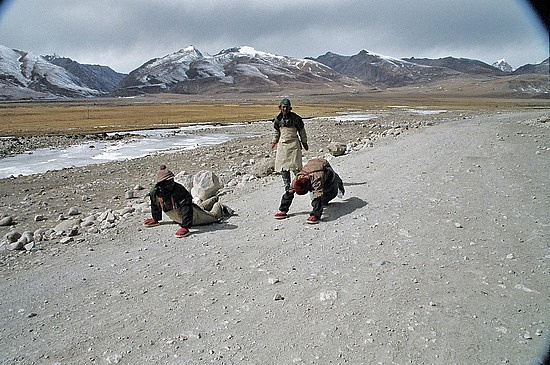
Ngondro is one thing- a practice that I value and feel is too often treated as just a preliminary that is to be rushed through, but how is chaplaincy different? Can it be any different? When we really look, can there even ever be a difference?
Milarepa never did ngondro, nor did Naropa- they had the benefit of having their teachers skillfully put them in difficult circumstances. At first glance it could be thought that it’s just hardship and difficulty that is implicit in these kinds of challenges; but when you look a little closer, it looks more like what is happening in through these experiences is that the view is being clarified.
What is being clarified, or purified? How is it really purified? These questions are both rhetorical and actual and beg to be asked. Blindly following through a ngondro pecha may be better than killing insects, but perhaps only in that it plants seeds that one day one may actually practice ngondro. And when we actually practice ngondro, where is there anything that exists outside of that practice? Refuge is everywhere. The experience of Vajrasattva’s non-dual purity of unmodulated mind is everywhere. The accumulation of merit arises with every breath. The lama is everywhere. Yet when we don’t “practice” ngondro what happens to refuge, the essence of purity, the accumulation of merit, and the blessings of the lama and the lineage?

I feel that there is a lot of wisdom in being able to rest into the awareness that accompanies being. It acts as a reset button of sorts that allows us the ability to see things more clearly, to appreciate the richness of whatever arises without creating conflict, and to meet others where they are without needing to change them. In this way, and with this perspective as a motivational factor, the world around us has infinite potential as a ground for practice. New York Tsurphu Goshir Dharma Center becomes as meaningful as Bodh Gaya in India, Tsari in Tibet, and yet is no different from sitting on the subway of being surrounded by the overwhelming bustle of Times Square, as everywhere can be the center of the mandala of the experience of reality as it is. It’s impossible for everywhere and everything to no longer function as the ground for practice.
This is the wish-fulfilling jewel quality that can be associated with resting in being with all of the equivalencies that surround us. This is an expression of the multi-valent interconnected relationships that imbue our experience of reality with all of the qualities associated with pure appearance as described in dzogchen, mahamudra, the pure view or sacred outlook associated with yidam practice, and quite possibly the experience of grace in Christianity, or wadhat al-wujud, the unity-of-being as described by Sufi master Ibn ‘al Arabi.

So whether you are helping to renovate a place of dhrama practice, or simply liking it on Facebook, or enduring trials similar to those of Naropa, Marpa and Milarepa, or laying in a hospice bed in Queens, New York, who is to draw distinction between the type of, or depth of experience that we undergo?
Can we quiet our mind of endless comparisons? Or allow for the mind of analytic distinctions to settle itself?
In doing so, perhaps the simplicity of being that arises reveals a constant soft rain of blessings and opportunities for authentic clear being. May all beings taste this ambrosial nectar expressed by the blissful knowing glance of all of the mahasiddhas of all traditions in all world systems. Gewo!
On resting with Tilopa…

Recently I have found myself returning to some of the amazingly pithy meditation instructions attributed to Sri Tilopa (988-1069), the well-known Indian Buddhist mahasiddha who was the forefather of the Kagyu lineage. His short, often poetic instructions, are something that help me in my personal meditation practice, as a ground for keeping myself feeling dynamic and internally connected as a chaplain, and in explaining to others the vajrayana perspective regarding what arises within the approach to death. An example of such an instruction is as follows:
If you sit, sit in the middle of the sky.
If you sleep, sleep on the point of a spear.
If you look, look upon the center of the sun.
I Tilopa, who saw the ultimate, am the one who is free of all effort.
The expansive clarity of this type of instruction, for me at least, is very resonant- it offers a way to feel my experience of mind blend into the wideness of space while also experiencing a sense of focus; a relaxed single-pointed experience of breath, sound, transparency of thoughts, and edgelessness. When this experience arises I feel very connected with Tilopa, as well as the other Indian mahasiddhas Naropa and Maitrepa. Sometimes however, I feel that I need a more graded approach to this experience of mind. When this occurs, I tend to lean on Jey Gampopa for support.
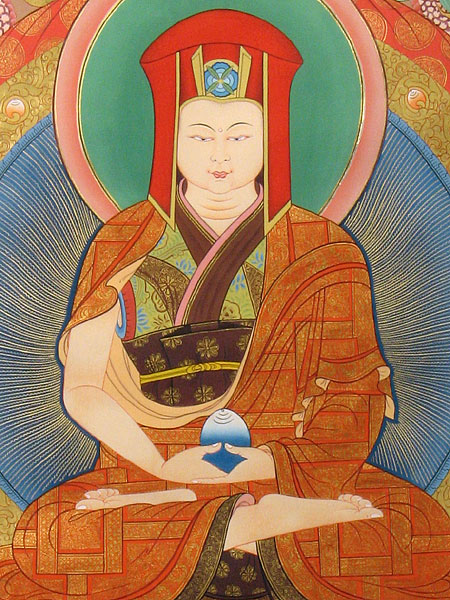
More specifically, I rely upon Gey Gampopa’s Precious Garland of the Supreme Path, and even more specifically I come back to the 5th chapter of this wonderful text: The ten things that you should not abandon. I had the wonderful fortune of receiving instruction on this text by the Venerable Khenpo Lodro Donyo, abbot of Bokar Ngedhon Chokhor Ling, in Bodh Gaya in the fall of 1998. This was during one of the many Mahamudra seminars that the late Kyabje Bokar Rinpoche held- truly magical times when we could all sit together under the bodhi tree to recite the 3rd Karmapa’s Mahamudra Aspiration Prayer, spend time in meditation- simultaneously touching our original nature- as well as physically touching the ground that supported the practice of all of the generations of Buddhists who had come before us in Bodh Gaya back all the way to Shakyamuni himself.
It was in that environment, and within that emotional frame of mind, that I came to learn of the ten things that one should not abandon. These ten things are: compassion, appearances, thought, mental afflictions, desirable objects, sickness (suffering and pain), enemies or those who obstruct our practice, methodical step-by-step progress, dharma practices involving physical movement, and the intention to benefit others. Gampopa’s list is very sensible, it is noble in the sense that it seems to be endorsed by Santideva himself; it is imbued with a heartfelt concern for the welfare of others as well as a methodical presentation of the training to see that appearances- be they attractive or not- are just mere appearance. The misapprehension of appearance, or appearance as taken as an independent entity separate from ourselves, is the very cause of our experience of suffering. As with all great dharma texts, it is heartening to see how just one small portion, in this case the 5th chapter of a 28 chapter text can offer the entire path to realizing one’s essential nature.
In looking back at the notebook that I have from the session when Khenpo Rinpoche taught this chapter, I can return to my exuberance not only for this chapter as a whole, but for Gampopa’s explanation of how one should approach the non-abandonment of mental afflictions. As a chaplain, when I am in the hospital, I very rarely meet people who desire to not abandon their experience of suffering: their fear, their psychic pain, their feelings of abandonment, of futility, of anger, or attachment to family- let alone attachment to ideas of how their life should or shouldn’t unfold. This experience isn’t unique to the hospital either- I and most of the people who I know spend a great deal of time fighting with these emotions. Perhaps this is why they are called mental afflictions.

Anger, attachment, pride, jealousy, ignorance. When we really sit quietly with these words they are not just words- they are worlds; worlds of suffering, worlds of feeling like we are right and others are wrong, that we don’t receive the credit or accolades that we deserve, that if only I had this, or was a that, then things would be the way that they should be. On and on and on…
Gampopa advises us to try three modalities with regard to facing and not abandoning our mental afflictions. We can avoid them- that is, avoid whatever causal conditions that might make them arise. We can transform them- or try to transform what these emotions unlock within us. Or finally, we can rest in them as they arise. Whichever modality we tend towards, there are two things to remain mindful of; how we habitually fall into one of these three modalities, and the degree to which we can honestly assess our relationship to that which we struggle with. Each of these ways of facing and not abandoning our mental afflictions can be techniques of liberation or techniques of seductive self-enslavement.

The process of avoidance is a very grounded, stable and well-meaning way of not abandoning our mental afflictions. It honors the way they arise- it honors their root- without forcing us to become affected. This way of approaching difficulties, painful habits, and stubborn aspects of our identities allows us some distance from the “heat” of the moment that comes with embodying our reaction to our mental afflictions. One could even go so far as to say that this modality is somewhat analytical in approach, it is disciplined and measured. The shadow aspect of avoidance is not acknowledging the mental afflictions that bring us pain and suffering. Not much good happens from simply ignoring things, or not letting aspects of ourselves have the light and air that they need to grow. Right now, the shadow of this modality comes to mind in the form of the image of a neglectful parent who doesn’t want to see who their children really are.
Transformation is a common methodology that one finds in the various levels of tantras. It involves playing with the way that we perceive our mental afflictions. This type of restated relationship allows us to meet head on those feelings that would normally make us want to run away. In this way the dross becomes pure; the dirty is seen as clean; and that which torments us achieves the possibility of bringing meaning and peace. True lighthearted transformation- transformation with ease- is hard to effect. Transformation has a terrible shadow side that involves the desire to fix; or more bluntly an inability to meet things as they appear without making them into something positive. As a chaplain, I witness many people struggle with maintaining a relationship with difficulty and pain, uncertainty and loss, and sickness and death without trying to “fix it”. The constancy of a “make-it-better-plan” can be exhausting and create untold suffering. It feels profoundly important to examine how this modality of maintaining a relationship with our matrix of painful emotions can relate to a desire to not allow honesty around what we are feeling and from where the roots of these emotions arise. (Here is a link to the related shadow of spiritually bypassing.)

Resting in whatever arises, the third modality presented by Gampopa, and the favorite of Khenpo Lodro Donyo while he was teaching, is an instruction that one commonly finds within the Kagyu and Nyingma traditions. It is profound- and it also very difficult to do honestly. As we saw earlier, anger, attachment, pride, jealousy and ignorance are powerful. To rest within rage for example- to feel one’s pulse quicken, and heart beat heavier and louder, while one becomes physically tight and flushed, as the explosive heat of anger and impatience engulfs us- is not a particularly comfortable feeling. (For a look at some of the difficulties involved with taking on these fierce emotions, you can read a previous post on Mahakala here.) Then there is the “resting” part. This term gets thrown around very often that I wonder if it doesn’t end up having a multitude of meanings nowadays. I know that I have met Buddhists of other traditions that take the term literally and assume that it is akin to taking a nap or “resting”.
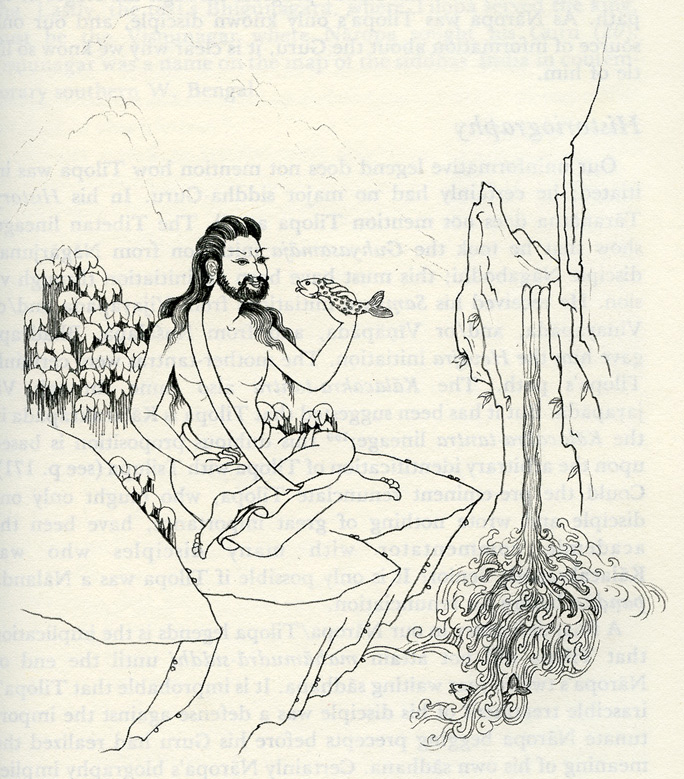
Resting actually refers to maintaining a focused (often described as ‘single-pointed’) awareness of appearance as it arises in the moment. In this way, Tilopa’s instruction from the beginning of this post seems a wonderful way through which we can re-engage the term resting. One quality of resting is being at ease. In this sense when Tilopa refers to three different ways of being- siting, sleeping, and looking- he is referring to three ways that we can rest in what arises. We can do it formally, as in sitting practice. We can do it within the experience of sleep, mind appearances arise when we sleep just as when we are awake. Finally, in looking, perhaps a passive “every day” experience as well.
If you sit, sit in the middle of the sky.
Where is the middle of the sky? The true middle? Where are its edges? Where does the sky end and something else take over? As we sit and remain resting with a sense of ease can we feel the expansive qualities of our minds? Where is the edge of our mind? What does a thought look like? Does it have a source that you can identify? Where do thoughts go when they are no longer so magnetic?
If you sleep, sleep on the point of a spear.
When our thoughts feel sticky and magnetic, when it is hard to not feel drawn into them and let our inner film projector play, what happens when we remain concentrated? What does that “single-pointed” awareness feel like? When we can feel and notice our breath; when we can maintain focused awareness on the way the inner film projector plays; on how a particular thought will hold us within our inner gaze, what do we notice about our experience?
If you look, look upon the center of the sun.
When this focus can be maintained as we look out at the world as it goes by around us, where is the sense of stillness? From where does that arise? What happens to the way that you notice the way that things arise while maintaining a focused awareness upon the expansive quality of our minds? Is there ever not enough room for what arises within our field of reference?
I Tilopa, who saw the ultimate, am the one who is free of all effort.
What if removing all effort was all that you had to do? What would it be like to maintain that within your experience of life?
Instructions such as the ones that Tilopa left behind for us are rare and powerful. It has been roughly one thousand years since Tilopa passed away, and yet through these four lines it is amazing how much of a connection we can feel with him. Five generations after Tilopa, Gampopa further crystalized the importance of being someone who “is free of all effort”. And while there are may pitfalls around how we may feel that we are directly engaging what arises within the moment, there is much beauty in the journey. Perhaps, slowly moving through life, through the wonderous field of appearance, we can increase our sense of ease and relax into an experience of effortlessness. What an amazing thing to aspire towards.
On the importance of certainty…

As a chaplain, one thing that I frequently come to witness in the hospital is the relative personal theological certainty that the patients I meet have established throughout the course of their lives. Naturally the range of established belief is wide and varied; it includes a variety of orthodoxies (Greek, Russian, Jewish, Muslim), as well as the views of moderately liberal faiths such as followers of the Episcopal church, reform Jews, progressive catholics, as well as passionate Pentecostals, Jehovah’s Witnesses’ and Baptists. There are also Wiccans, New Age folks, and a whole host of individual prophets of the new age who I come across.
Just last week one man shared with me his belief that Jesus was more akin to Obi Wan Kanobe and Yoda than anyone else seems to realize. For this man, the essence of God is much more similar to the Force than the compilers of the Bible could understand. In fact, rather than feel with his “heart”, a common human metaphor for the seat of emotion, especially as the seat of love, he told me that he feels with his larynx. After all, in the beginning was the word….
The certainty that this patient expressed regarding his inner beliefs felt palpable, and lead me to wonder about certainty. I can only really speak for myself when I say that I can never really know how true or theologically sound the spiritual underpinning of any given person who I come to meet with may be. I have my own biases, my own stubbornness, and without doubt, I have plenty of blind spots. To have a full understanding, in an ultimate sense, of the beliefs of others- or in other words: to truly know how right or correct how full or effective a particular path that another person treads, for me, seems to be an impossible task. Just like trying to hold water in my cupped hand for any length of time, such definitive knowledge escapes me. In fact, I often wonder where the utility of trying to know such things may lay- it seems like trying to know if the person next to you sees the color blue in the same way that you do. Is there even a right blue? What is blue?
What is everything for that matter?
What is mind? What are thoughts? What are feelings? Are they different?
What is Buddha-nature? How do we recognize it?
What are our dreams? How are they different from waking life?
What is meditation? How is it different from hustle and bustle?
How are we suffering? What is the cessation of suffering? What does that mean for you?
How are we not shackled by discursiveness? What does that mean?
What is certainty?
This particular question seems to touch upon and lead us to something that we may be able to come to know, albeit with effort and focus. Certainty suggests a lack of doubt; a knowing born of experimentation; security from error. Ultimately, it may be that entry into the realm of certainty is an intensely personal process. Spiritually, I feel that the tent poles of certainty are planted, and firmly fastened through wrestling with instructions left behind by the traditions that we follow. Once we have come to appreciate these instructions, internalize them, digest them, and come to know with confidence what they mean, then we may fully know the secure and tender shelter that our tradition affords us. Only then do we see that the words found in our dusty books are in fact thick golden ambrosial nectar, and that the experience of life can become more of what it is: alive, fresh, and full of energy. Even as it wanes, this life of ours, subject to pains, worries, sorrows and regrets still holds the unique and ever profound richness of spontaneity and depth of meaning.
The work of distilling certainty from our experience of, and interaction with life asks us to try to see ourselves for who we really are. It asks us to understand our outer, inner and secret anatomy. It also leads us to a taxonomy of self- a clear reflective understanding of who we are- for it is only through knowing who we are and how we experience our life that we can understand how to enter into relationship with developing greater awareness of what being open and more free means. Openness and freedom, for me, tend to be something that I associate with the flexibility needed for solidifying these natural attributes, for providing ground, for being able to really see who we are.
Then there is who we are in relationship to our tradition. Tradition and lineage can take a number of forms, but in its most essence oriented function, tradition and lineage speak to how we become who we are in time and space. In this particular case it isn’t about adopting a particular set of beliefs or perspectives, but more how the integration of lineage perspectives cause us to individuate within our lineage; in essence how we become more ourselves- empowered and confident, free and self-assured. It may very well be that we come to find ourselves within the natural ebb and flow of our tradition or lineage without much to really do.
How this comes to be, of course, may be impossible to fully explain- except in relation to our own journey. Such inner-transformation is very personal and unique to each individual. This fact is easily gleaned from reading the lives of the eighty-four mahasiddhas. The story of their processes of liberation often involves embracing circumstances unique to each master’s life. Whether it be using a goiter as a focus for stabilizing the mind, or a fabulous jewel, trying to steal the essence of mind to ascertain its nature, or the use of conceit as a means for attaining siddhi in arising as the yidam, nothing was spared. No fear too mundane; no shadow too dark. In fact, in these stories we can easily see how structured aspects of practice lineages were transposed upon, or woven throughout, the experience of the lives of each mahasiddha. The result of such a skillful weaving, a blending, or circulation (circumabulation) of tradition within the experience of life is twofold- the experience of being becomes easily imbued with simplicity (an expression of simple appearance) and offers the possibility of complete fiery annihilation of obscurations.
Paradoxically, such seemingly simple self-styled practice requires not only a sense of openness with regard to exploring who we are, what we are, and how we function in the world- but also knowledge of our lineage, particularly certainty in its effect. The stories of the mahasiddhas are very approachable, and should be read by everyone. A few examples can be read here. These stories really capture the depth and simplicity of a well grounded and distilled practice and offer a kaleidoscopic expansion of experience that I have come to value. From the simple comes everything, the full richness of a practice lineage with all of its subtle distinctions.

The other day a friend of mine who also happens to be a chaplain and a rabbi reflected to me a growing concern, namely that religion and religiosity are increasingly something that people are distancing themselves from- and that even spirituality is something that is regarded with some suspicion. Her larger point focused around the need for a wider tool-kit for chaplains that allows for the inclusion of people for whom feelings of connectedness may not be centered around religion and spirituality. The tool-kit that she refered to invariably requires her, and anyone who wants to be able to be there with others in the exploration of their location within the axes of spirituality and religion, to know their location and the story of their journey (how they got there). If these aspects of ourselves are unexamined how can we help others? More broadly, without knowing where we are and how we function in relation to our individual traditions how can we hope to integrate them into our lives?
This point speaks well to the establishment of certainty within our spiritual practice as it invites us to wonder what we feel about religious thought. Do we consider ourselves religious, or, do we tend to think of ourselves as spiritual? Is there a difference? What about those two words hold intense reactions and why?
There is no right answer, only our own- which if it is an honest one, can hold up to a little inquiry, and also be allowed to change as we change.
I bring my friend’s point up because in many cases real training (study, receiving instruction, practice, and reflection) within our individual lineages is very important for gaining certainty in the path, as well as what is possible. Within the model of tantric buddhism this process is described as the Ground, Path and Fruit.
The Ground represents the larger theory, the teachings on the way the mind works, how suffering arises, how the dharma can eliminate our experience of suffering. The Path is primarily the method of putting this dharma into practice- really blending it with our experience of life. The Fruit is the true naked experience of mind- an experience of seeing, feeling, and really knowing the Ground to be alive within our experience of being. Certainty can be, and needs to be known in all three relational models of buddhist practice, or however many stages we experience within our own particular liberation story.
Certainty in Ground. Certainty in Path. Certainty in Fruit.

I wonder where the mahasiddhas Luiypa, Saraha, Ghantapa, Tilopa,Virupa, Aryadeva or Dhokaripa would end up without their experience of certainty upon their paths and within their experiences?
In what way do we need to attend to the development of certainty within our own experience? Can we allow ourselves the room to attend to these needs without regard to how we appear to others? Can we approach certainty with honesty? From a place of deep personal concern?
Some may feel the need for increased study- a real immersion in the Ground. Some may feel a need to develop more confidence/familiarity with the Path. Others may feel a need to open themselves to the possibility that they may indeed experience the Fruit.
Jey Gampopa (1079-1153), the first monastic lineage holder of the Kagyu lineage wrote in his famous work The Precious Garland of the Supreme Path, that we should protect our practice just as we would our eyes. Similarly, I wonder if we should regard the maintenance of certainty in our practice as we would not only our eyes, but the rest of our body. The distillation of certainty is a process that is subtle and mysterious. It is not necessarily obtained from taking classes or attending lectures, nor from reading books or studying, and yet it can sometimes be gleaned from those activities as well. Sometimes we may experience it in a flash of anger or humiliation, or as a sudden joy. Nevertheless, however it arises it arises from within- it is a fruit born from an inner journey that if deep and genuine leaves us naturally settled, grounded, and in harmony with the arising of phenomena. It is a mysterious inner-organic manifestation that like the morning mist is hard to pin-down and locate. Perhaps, only when we let our defences down, when we shed our firmly held ideas about things that certainty becomes a possibility. When that happens, the distinction between who we are in relation to our lineage is more a question of us just remaining who we are, not much else remains for us to do.
On Buddhas behaving badly…

The other day I heard a story on the radio about the rise of the anti-hero in current television programing. Apparently there is a growing number of television shows for which the main character is an anti-hero; a figure whose moral equations and ethical concerns follow a personal arc that often falls outside of the norms of the larger group; sometimes walking the line between good and bad; sometimes navigating those places that we fear to go. One example of such a show takes place just after the American Civil War in the vague liminal space of the farthest frontiers of the Union Pacific Transnational Railroad- the very edge of civilization. It tells the story of a racist ex-confederate soldier and former slave owner who hunts down union soldiers (the historical good guys) for the crimes they have committed. Another example tells the story of a highschool chemistry teacher who after a diagnosis of lung cancer, decides to work with a former student, to “cook” methamphetamine, a terribly addictive and dangerous drug, to pay for his medical treatment in the short-term; and, being a realistic man, to provide financial support for his wife, teen-age son who has cerebral palsy, and his new-born daughter. He and his partner explore the dark world of methamphetamine and the shadow figures who are involved in its distribution. They are occasionally forced to kill the ruthless for being cruel, and are often driven by a clear sense of right and wrong in a world of darkness where such distinctions as right and wrong have been forgotten long ago. Sometimes that clear judgement seems to fall prey to the induced darkness that they frequently encounter. There are yet other similar television stories too, including the story of a serial killer (the anti-hero) who only kills other killers, and has a love for, and natural connection with, children.
For those who are interested, you can listen to the radio clip that I listened to here.

The presentation of these anti-heros as an archetypal “dark Hermes”, a guide for lost souls, or as a guide for well-oriented souls as they transition through, or are completely lost in, a place of darkness, leads me to reflect upon pawos, palmos, and the retinue of very important wrathful buddhas. I am reminded of those who protect, and those who serve in places and at moments where we seem weak and desperate, those who as part of their unique activity can serve compassionately through, for lack of a better term, dark means.
These beings, Mahakala in all of his overwhelmingly powerful manifestations, Throma with her army of dakinis, Vajrakilaya with his phurba of non-referential space, and Yamantaka (Vajrabairava) the destroyer of Yama (the lord of death), occupy an important place within the practice of all lineages of tantric buddhism. They have also been the most controversial. From the perspective of the academic study of Buddhism in the Indian subcontinent and Himalayas, many early western scholars of Buddhism regarded tantric Buddhism as a corruption of the Buddha’s original message. Tantric Buddhism, and tantric Hinduism for that matter, from this early scholastic point of view, was seen as a distortion of the orthodoxy; a blend of Buddhism and Hinduism with gross superstition, animism, sex, magic and the more base drives that lead us poor humans hither and thither. Jacob P. Dalton, in his recent book The Taming of the Demons: Violence and Liberation in Tibetan Buddhism, offers a clear and well thought out description of how some of the language and imagery found in the tantras have come to occupy a place of simultaneous attraction and disgust in all of the cultures the tantras have come to visit. It appears that the reactions of Victorian British scholars did not arises as an emotional island unto itself when it comes to the tantras- in Indian as well as Tibetan culture they were embraced and feared, accepted and rejected, praised and cursed.
Ironically, the shivering disgust and ambivalence of early western scholars towards tantric Buddhism reveals the power of becoming intimate with these feelings and reactions as they exist within ourselves. Superstition, animism, sex, magic, and our “base drives” can be sources of great confusion, great pain, loss of control, and even our undoing. Perhaps then it is no wonder that these aspects of our experience of life end up proving to be very powerful fodder with which we can develop confidence in our practice of Buddhism. As a chaplain I have seen patients, their loved ones, and even colleagues, struggle around these hard feelings- this is a struggle that we all share. No one person owns, or is cursed, with difficulty of struggling with guilt, shame, fear, loss, pain, and loss of control.

Within my own experience of life, I know that I often feel the push and the pull around my own anger, or sense of aggression, my impatience, my jealousy and my frustrations. These feelings arise just as generosity, patience, connection, and ease arise. The only difference is that when these harder feelings begin to swell, how they will affect me, either destroy or help to push me further along the path, seems to depend upon just how comfortably I can relate to them- how I can see them as they arise and honestly witness them- not quickly ignore them in exchange for something good. In my own way, one that changes from moment to moment, I have come to learn just how much I can be with these feelings in myself and see them as beneficial arisings. Not just see, but experience them as beneficial arisings, or as the 3rd Karmapa, Rangjung Dorje, refers to these thoughts/feelings, to see them as “adventitious stains”. Stains that are adventitious as they help point out the one-taste in whatever arises.
Bokar Rinpoche once said during a series of teachings in Bodh Gaya that Tibetans complain to him the they don’t understand western practitioners as they are always seen sitting perfectly still and erect, like statues. Similarly he related the complaints of western students about their Tibetan counterparts who always appear to be doing prostrations and khora (circumambuting) the mahabodhi stupa. He went on to explain to the mixed group that both are useful forms of practice- and that we should learn to modulate between both. At one time one form of practice is more appropriate, and as that moment changes, so might the way we practice in that new moment. Sometimes one form of practice is more useful, more charged, and more fitting for one’s experiences of the moment. As the moment changes sometimes so does what is arising. I don’t think that we can recognize our stainless buddha-nature by practicing like robots. I suspect that engaging with our practice, and all the maras that arise, in an open honest manner is the way.
So what about us? Do we have a tendency to frame ourselves as hero or anti-hero. Are we all light and no darkness? Do we only benefit beings and never harm them? Do we have the capability to look at our practice with a fresh set of eyes and knowingly step into the unknown? Do we see ourselves as clean and pure, or as blended and pure? Can we allow ourselves to modulate? To mix our view of ourselves with a more realistic presentation of what really arises within our mental continuum?
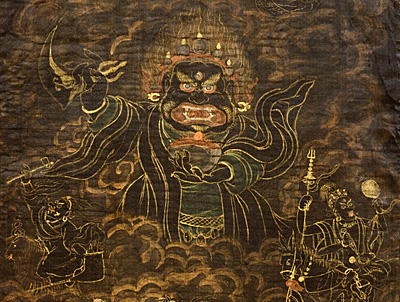
While there is no real difference between Mahakala and Chenrezig on an ultimate level, the experience of their relative differences can be very important- if not instrumental- in knowing who we are, how thoughts and feelings arise within us, and what the powerful energetic force of Mahakala is like. How else can we know equanimity in the midst of roaring intensity? Sometimes we need this to cut through our bad practice habits, our over-softness, and a predilection towards the positive- especially in a way that it’s too bent on purity.
Can we rest in the nature of mind amidst vice, transgression, and fear?
Such was a profound learning for many great Indian Mahasiddhas including Virupa, Naropa, and Saraha as well as many great Tibetan siddhas. In fact it still remains a profound and seminal learning for us today. When to be “good” and when to be “bad”?
In fact, I sometimes wonder if Buddhism isn’t too often presented in such a warm and fuzzy light in which it becomes easy to see the wrathful compassion of pawos and palmos as something other than and not of ourselves; something to be invoked from afar and for only getting rid of problems. Anger and ferocity are hardly rare emotions, greed and jealousy more often than not are not endangered, and tending towards a self-cherishing attitude is certainly one of the greatest thing that we all have in common. They arise from nowhere else but from within.
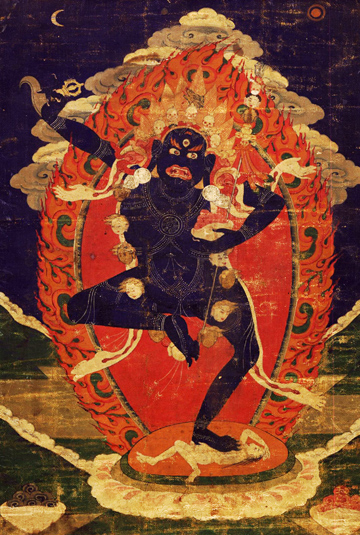
So why do we become concerned or uncomfortable when the “strong medicine” of Vajrakilaya or Throma becomes the prescribed remedy for our suffering. As the demon armies of Palden Lhamo ride past fearlessly destroying all impediments to our practice, effectively closing the door to our own limitations, and as the flesh-eating dakinis gratefully pledge protection and siddhis as we offer our own transformed inner poisons to them, where is the room for squeamishness?
Similarly, I sometimes find that when some dharma practitioners reference entering into in wrathful activity, I wonder about the presence of a facile idiotic aspect of “wrathfulness” that simply seeks to justify laziness. I know that this is something that I look for in myself as I know how seductive the pull to break the rules in an elevated way can be. Sometimes through the desire to engage in “transgressing the rules” and working with how those difficult emotions of knowing that you are doing something wrong or impure, we may actually be soft with ourselves around actually feeling like the rules don’t apply to us. To bring whiskey and ribs to a tsok can be one thing if we can hold what alcohol and meat mean in the context of an offering to mahakala for example, or it can be an insulting self-aggrandizing slap in the face to what a mahakala tsok is all about. Herein lies the conundrum: How and when are we really acting from a place of authenticity as we decide to behave badly for the common good of other sentient beings?

Knowing when to be bad, or when to challenge conventions is never really an easy thing. Such behavior asks us to be confident in ourselves, confident in our abilities, and comfortable with growth that arises from difficulty. This too isn’t easy- the habits of disempowering and brutalizing ourselves are strong. And yet, at times we must step into this aspect of practice; we must challenge conventions, habits and assumptions; we must find our ground and relationship with the strong and the dark, the wrathful and the powerful. For this is another side of buddha activity. Despite its danger (just one act of poor judgement can have terrible consequences), and the trepidation that can arise with knowing willful transgression there is a lot of room for growth in becoming friends with these expressions of “being bad”.
That said, this kind of practice may not be for everyone- nor I suppose is it necessary for everyone. Although it helps to take an honest look at what comes alive for us when we look at the images that are included on this post before saying, “nah, I don’t have any need touching my dark-side. I don’t think I even have one”. If these images elicit fear and concern, or feel attractive and seductive, or if they feel disgusting and repulsive then perhaps that is something to look at. If they feel foreign and “definitely not part of me” well perhaps another deeper look may be warranted. It may be that these natural reactions, honest indicators of what we really feel, hold a good deal of explanation of our relationship to wrathful Buddhas- about finding freedom within our difficult emotions, and remaining spacious when the right or wrong associated with where we are or what we are feeling is called into question.
How are we really when it comes to visualizing lakes of hot sticky blood these buddhas traverse, the flayed human and elephant skins that they wear as adornments, and the steamy snorting of the demonic animals that they ride?
What is being good? What is it to be bad? Our relationship with being good and with being bad can be very difficult and complex. The fear of blame and the need for praise, or quite frankly the inability to accept praise and the need for self-blame often affect they way we relate to much of the world. This is something to look at within ourselves. It may be that within popular culture the dark anti-hero is an increasingly popular metaphor, or even an archetype for where we are and what we feel we need; especially as the gravity of the simple good and bad, light and dark, simplicity of the dualism of our group ethics seems less pertinent. Perhaps we long for more- for different models of being, differing conceptions of justice that may include the liberating nature of wrathful buddhas. If this is the case, all we need to do is look within, and we will find a rich world, an endless thanka painted upon the canvas of our psyche that captures a limitless retinue of wisdom beings. May it be so!

A warm new year’s greeting…
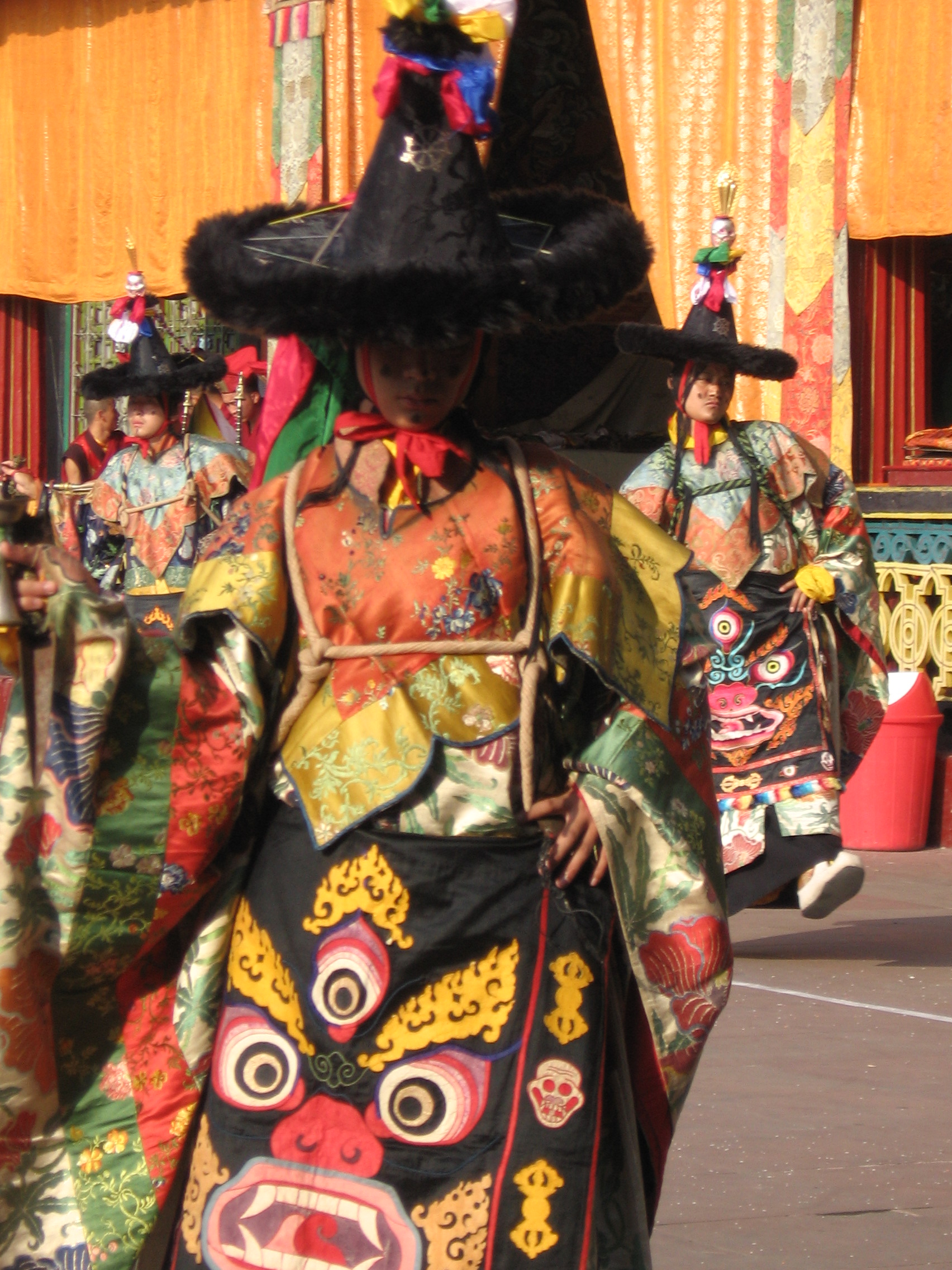
As 2011 dissolves away into another year I feel the need to offer a greeting to all of the dear readers of ganachakra. The wonderful support and warmth that you all offer me helps me to grow- it is a special relationship that we share; a relationship that I pray continues for many years to come.
With that said I pray that this “new” year is seen as just another momentary appearance; an expression of liberated mind.
May the mind be seen as beyond time.
May your practice be deep, and be intertwined with the blessings of your lineage masters.
May you effortlessly begin to empty the pit of samsara by benefiting all beings.
Gewo!
With respect and gratitude,
Karma Changchub Thinley (Repa Dorje Odzer)
On the view: the false dichotomy between dzogchen and mahamudra…

An old dharma friend named Jonny wrote me the other day with a question that he had. We had first met in 1995 down by Mungod in south India where he was teaching English at Drepung Loseling, and I was studying with Geshe Wangchen, under the kind graces of Lelung Rinpoche who at the time was dividing his time between Drepung Loseling and Nechung Monastary in Dharamsala.
Over the years as I came to meet and study under the late Kyabje Dorje Chang Bokar Rinpoche, and my path crossed with Jonny’s and other dharma friends amidst the annual groundswell of dharma that occurs during the fall months in Bodh Gaya. It was there that I had the opportunity to introduce Jonny to this wonderful oceanic meditation master. From that point onwards that my relationship with Jonny changed to that of dharma brother, which is where we are in this moment.
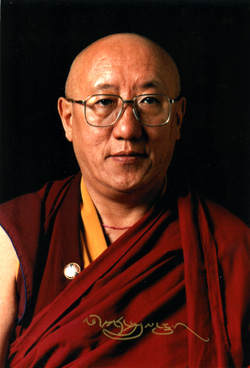
After the tragic, unfortunate death of Kyabje Dorje Chang Bokar Rinpoche, most of his students were left in a place of loss and sadness. The confounding suddenness of his death created a barren confusion- I remember from my own experience that this was a terribly painful and confusing time. The loss of a teacher can be very painful. I had felt that there was an intimacy in my relationship with Bokar Rinpoche that made him feel like a father- it took a number of years to be able to return to his seat monastery in India without feeling a profound sense of loss and sadness.
Over time the, winds of karma, the great teacher that might be described as the impermanence of appearance, blew Jonny into the lap of Yangthang Rinpoche, and I into the lap of H.E. Gyaltsab Rinpoche. As our experiences arising from meditation practice change, and as we slowly try to blend whatever insights that arise from such experiences into our daily lives, we email from time to time- to check in and see where the other is.

In an email last month, Jonny wrote:




On how to get soul: chod and the practice of freeing ourselves from slavery…

I was recently in Wilmington, North Carolina in late October for my wedding. It’s a very beautiful small town that hugs the Cape Fear river, which, like most early cities and towns, was dependent upon a waterway as a means of transportation, both out to the Atlantic Ocean, and also further inland. We spent a week down in Wilmington trying to add a few days of relaxation to the planning and organization of the wedding. While there I was able to spend a morning practicing chöd on the beach during sunrise. For a brooklynite, the ability to spend time in meditation facing the rising sun on a beautiful quiet beach is something of a luxury.
While I was aware of the fact that there had been an active slave trade in Wilmington, I had not realized the extent of Wilmington’s strategic location in the trade of slaves. Fortunately, or unfortunately, due to the danger of trying to moor ships on most of the islands that make up North Carolina’s Outer Banks, the Port of Wilmington, situated inland on the Cape Fear river was much safer, thereby providing a major point of forced disembarkation of slaves. In fact, the black slave population of Wilmington out numbered the white non-slave population by 2 to 1 by the mid 1800’s. The skills and knowledge of black slaves was vital for the growth, success and expansion of the town; it is quite probable that Wilmington’s survival as a vibrant economy due to its being rooted upon a firm economic base built upon the blistered and broken backs of its former slaves.
In this respect Wilmington is no different from a variety of other cities, towns, countries, and empires whose success, basic stability, infrastructure, and rich cultural growth has been secured and “enriched” by its slaves. Indeed, like it or not, the history of humanity can certainly provide a variety of such cases of how the enslavement of other humans “benefitted” the culture of their oppressor. Sadly, in many ways this dynamic continues into the present day.

With this in mind, and as a means of returning to the sacred geography that I explored in a blog post last year, I decided to spend time doing chöd on the beach not far from the inlet of the Cape Fear river; all the while trying to remain aware of my inner slaves and all the ways that I enslave different aspects of myself. I wanted to touch upon all of the ways that I enslave myself, enslave aspects of my personality, how I project rigid ideas upon myself, and like a coy and brutal slave-master, how I benefit from such suffering. That Wilmington can act as the support for my practice of chöd, that its rich history of being a place where the dreams of humans were crushed and suffocated by a racist ruling class can offer a ground and support for practice is important. Perhaps Wilmington, as a reminder- or symbol- offers us the potential for great inner growth.
Slavery, especially inner-slavery is an important thing to contemplate. Even more, the way that many people disassociate from the history of slavery and all of the ways in which it still haunts us is something that I find disturbing.
There is so much terrible violence that we commit towards ourselves in a unconscious manner out of fear, or a sense of insecurity, or of flat-out self- hatred. There are so many ways in which we subjugate aspects of ourselves, be they qualities, propensities, or habitual reactions, with the same control of a slave master.
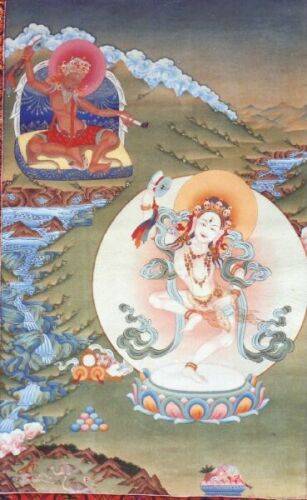
And so, with the warm rising rays of the morning sun as a witness; a glorious bindu drop amidst the crashing of waves of the atlantic ocean, and with the wind whistling though tall beach grasses, I invoked the mandala of Machik Labron and Prajnaparamita. With qualities of edgelessness, and without specific orientation within time or space, I wanted to stretch myself , so that the tragic history associated with the slave trade and all of its ghostly remnants could be included within my practice, that all of the terror and the brutal subjugation of others could be heard.
I tend to feel that with any particular spiritual practice it is important to blend what tradition dictates, the transmitted instructions of one’s teacher/tradition, with what is alive within ourselves. At the end of the day it is our story, the story that we carry with us, the story that we have made for ourselves that we bring to our practice. The way that we construct this story, it’s highs and lows, it’s holy sanctified ideals and its skulking demonic shadow beings are what we bring. Our desire to do, and be, good, as well as our fear of failure and being seen as failure.

In exploring slavery as a metaphor for the way in which we fail to notice our full selves I am reminded of course I took in college on African Philosophy taught by a brilliant Kenyan philosopher, Dismas Masolo. Some of what was touched upon within the curricula of this class included an examination of the early historical affirmation that Africans were in many ways sub-human.
For example, Immanuel Kant, one of the giants of western philosophy writes in Anthropology from a Pragmatic Point of View: “Humanity exists in its greatest perfection in the white race. The yellow Indians have a smaller amount of talent. The Negroes are lower, and the lowest are a part of the American peoples.” Martin Cohen, the editor of The Philosopher, wrote in a review of D.A. Masolo’s African philosophy in Search of an Identity, “…Kant, for example, had argued that the ‘original human species was white, appearing as dark brown’ only as a result of oppressive climatic conditions, whilst Hegel wrote similarly that ‘the characteristic feature of the Negroes is that their consciousness has not yet reached an awareness of any substantial objectivity’. In Africa, life was not a manifestation of dialectical reason but rather, as Hegel put it, ‘a succession of contingent happenings and surprises.'” The justification for subjugating others appears timeless- it is amazing how easily we demonize others, sometimes with shameless effortless ignorance.
Equally amazing is how we take credit for the fruits of the work of our inner-slaves. Just as the slave owner assumed ownership of what was tilled within, and born of his fields; or the madame at the brothel whose “hard-earned” wealth was collected upon the broken bodies and broken dreams of her two-bit whores (to quote Theodore Dreiser); it can be scary when we look at how much credit we take for the fruits of the parts of ourselves that we would rather ignore, the parts that we keep drugged, shackled, and subdued with cruelty.
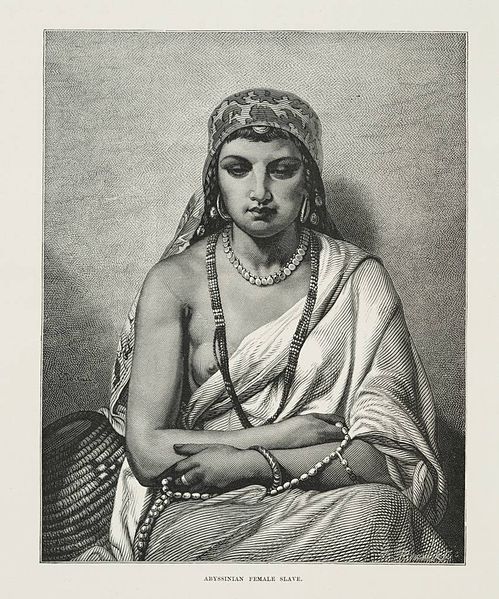
While we assume our position at the head of the table, decked out in all of the fineries of our best projections of ourselves, dining upon the finest foods, receiving the accolades that deep down we feel we really deserve, entertaining our every whim and fancy- our self-hatred and inability to dynamically embrace the parts of ourselves that we may fear that others will come to know of often rules with the same tight fist as the cruelest slave owner. And just as such slave owners were known to rape their slaves, I wonder how we secretly rape the unintegrated parts of ourselves; secretly proclaiming love and acceptance of the parts of ourselves that we may indeed love, but fear, and perhaps secretly hate because we feel that we may know that they are integral parts of ourselves.
Ironically, it may just be that the most enslaved parts of our psyche may be the ones that we refuse to own; the ones of which we refuse to be conscious. They also may hold immense power and utility, if we could just be with them, just accept them…

As a chaplain I witness many people (patients, their friends or family, as well as staff) try to shackle their fears, to hide away their anger and sense of loss, to turn away from their sense of powerlessness, and to try to disguise their shame. I can see this in part because I try to explore these things within myself. It is not easy to notice things about ourselves that we are uncomfortable with- let alone loathe or fear. And yet in seeing this in myself and in others, I am often reminded of how naturally we create our own suffering.
I sometimes wonder about how as Buddhists it is possible to secretly hide away the slaves of aggression and anger, how easy it is to distract ourselves from truly knowing, exploring and interfacing with the way these feelings arise. That we might prefer studying the paramitas as a way of feeling good about ourselves but not really noticing, not taking stock, of how easy it can be to associate with a conceptual modality, a structural paradigm, rather than something that genuinely arises from our heart/mind complex. Even the idea of Buddhist practice offers a false sense of not being a slave owner. In this way, the overly friendly, overly compassionate Buddhist who is unaware of the horrors bubbling just under their surface can also become a slave owner by brutality repressing drives, emotional impulses and feelings. If not observed carefully, Buddhist practice affords wonderful ways of running away from oneself (if that is what you want to do).
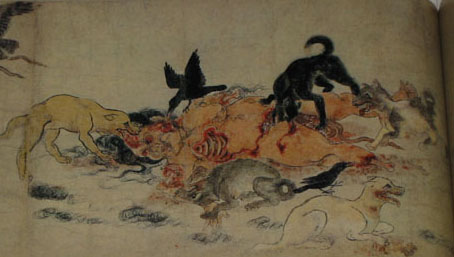
In offering my steaming organs, the sun and moon of my eyes, the deep vital essence of my marrow, the mountain range of my fingers and toes, the ocean grasses of my hair, my flayed skin, the ground of the mandala offering, I contemplated what freeing a slave means. If I am to free my inner-slaves shouldn’t I do so in a way that allows for having a relationship with them in the future? Wouldn’t that presage deep growth and acceptance around just why I ghettoized an aspect of myself? And in having some sense of how and why I do this to myself, around my conception of myself, doesn’t this offer a wonderful means of connecting with others who find themselves with a whip in their hand, or fist raised in the air towards themselves?
In consciously releasing our slaves, with awareness, offering witness of how we maintained them for years, perhaps even a lifetime, I wonder if we can also allow them to remain part of us, in relationship with us, as liberated beings; liberated parts of ourselves? If this is the case, then the story of our aggression towards these ways of feeling is an important and powerful thing to honor. Knowing these stories around and within ourselves can create a natural sense of connection and intimacy with others in a way akin to the paramitayana. It may very well be that this awareness of our emotional history is central to honestly approaching the paramitas. Otherwise it can be very easy to inadvertently use the dharma as a tool to subjugate and maintain slaves. There may be the desire to release our slaves and “banish” them from our sight so that we never have to see our folly- this however prevents any honest growth and real witness of the story of our inner-ghetto beings.
I suspect that as we become more familiar with freeing our slaves and trying to maintain relationship with them, in accepting the hard truths which can become precious gifts, we can relax our grip around things specifically needing to be a particular way. In letting go, forgiving, and remaining in relationship, the dharma doesn’t become any one thing in particular; it becomes all things.
We, the creators of the new black generation,/ want to express our black personality/ without shame or fear/ If this will please the whites, much the better/ If not, it does not matter/ We know ourselves to be beautiful/ And also ugly/ The drums cry/ The drums laugh/ If this will please the whites, much the better/ If not, it does not matter/ It is for tomorrow that we are building our temples/ Solid temples we will ourselves know how to/ construct them/ And we will keep ourselves straight/ On top of the mountain/ Free in ourselves. -Langston Hughes
on taking things for granted, and how we spiritually bypass…

In re-examining The Biographies of Rechungpa by Peter Alan Roberts for an earlier post, I came across details surrounding the colophon from the Life and Songs of Milarepa that are quite illuminating. Roberts suggests that the 14th century collection of songs, known as the Life and Songs Shepay Dorje, the source for what is popularly known in translation as The Hundred Thousand Songs of Milarepa, was actually intended to be a secret text; a text with a limited readership- a special means through which one might receive instruction and inspiration from Jey Milarepa himself. I find it particularly fascinating that this book, which can commonly be found in any number of bookstores, was once intended to only be shared by repas who were undergoing training in a manner similar to that of Jetsun Milarepa and his cotton-clad disciples. This piece of information illustrates, for me, how easily I have taken this book for granted as well the height of regard for which this particular set of teaching songs has been held.
Of course this is common with many books that one finds in any section of a bookstore that offers a selection of books on Tibetan Buddhism or Vajrayana. One can easily purchase translations of The Six Yogas of Naropa, or texts on Mahamudra or Dzogchen, Yidam practice, Chöd and other topics whose surrounding lineages of practice are still kept secret and guarded out of respect for the efficacy of such practices. Very few Tibetan monks, and unfortunately even fewer nuns, had access to these same texts that we now throw in the back of the car, fail to re-shelve at the bookstore, or even just casually leave out on a coffee table or the floor for that matter. If we like, for not that much money, we can purchase a translation of the Chakrasamvara and Hevajra Tantras or commentaries of the Guhyasamaja Tantra. You say you want a copy of the Karnatantra; the Bodyless Dakini teachings that Rechungpa brought from India to Tibet? No problem- if you want, it can even be delivered right to your home.

It’s fair to say that the genesis of most of these works is unknown. By this, I mean that while there may be a known attribution and transmission lineage specific to each text; a world completely unto itself; it took an unknown process that lead to the spiritual experience which inspiried the composition/revelation of these texts. Truly understanding what rests at the source of these works, and what they point out is difficult. The experiences of Tilopa or Naropa, of Aryadeva, or Krishnacharya are difficult to fathom. Yet we have their works in translation- manuals of liberation techniques, pages blessed by the buddha qualities embodied by each master who revealed them. While the majority of tantric Buddhist texts haven’t been translated, those that have- core lineage texts- are readily available.
One might ask, “Well, if access to all of these wonderful meditation manuals is so easily obtained, this must truly be a boon for our practice, no?” Indeed, this is a wonderful thing, we are very lucky to not have to risk our life to obtain access to the dharma as many in the past have had to. And yet, every wonderful thing also has a potential shadow, and I wonder about how easy it is to become jaded by all this easy access. Occasionally, I worry about easily we take for granted just one book which may represent the entire life experience, the great inner struggles and blissful insights, the fears of mediocrity, and the sense of grounding of such great teachers like Milarepa, and Machig Labdron, to name just two. Just one book contains the realizations of an entire lifetime. It contains an entire world. Yet it is easy to find that one book is often replaced by another, consumed with an ease and sense of entitlement that may perhaps undermine the very sacred meaning behind the genesis of each book. It is quite possible that before we know it, we have a personal library of the translated oral instructions of a variety of wisdom traditions while our inner spiritual flame, our interior process, struggles to maintain itself. It’s easy to take all this wonderous access for granted; to become “spiritually engorged”.

Chögyam Trungpa Rinpoche treats this problem within his classic work Cutting Through Spiritual Materialism, and Robert Augustus Masters offers a wonderful honest treatment of this within his work Spiritual Bypassing: When Spirituality Disconnects Us from What Really Matters. Spiritual bypassing a term for the way that we use our spirituality to separate us from honestly feeling our emotions and from using our spirituality to defend our own faults and shadows. It is amazing how little growth and self-exploration we can allow ourselves through justifying our habits, our easy reactions and our shadows by chalking them up to “wrathful activity” (You know, I’m angry and that’s why I practice Mahakala), through the nature of ultimate reality (It’s all just an illusion anyway), or by being overly nice and compassionate as a means to feel better about ourselves and (sometimes to make us feel better than others).
What happens when we become jaded? When we say things like, “yeah, I know about all of the aspects of completion stage meditation from all the books that I have read”, what are we really saying? It sounds to me as if we have cut ourselves off from intimately knowing ourselves. It sounds as if we are hiding behind knowledge and not allowing the often messy and painful process of insight and wisdom about ourselves to occur.

I have come across a number of very well read Buddhists who have read and memorized great quantities of Buddhist texts who also seemed to lack basic concern for others- who would snap at those with lesser learning, and even refuse to offer support for those around them who were struggling. As if hypnotized by the wonderful image of the inner cartography that they were studying, they had become separated from the awareness that in order to start a journey we must put the map down so that we can actually begin. If we try to read a map and walk simultaneously we easily lose our orientation.
I’ve also seen many folks shun basic bodhicitta practice for practices that deal in a more head-on way with emptiness; more secret practices, higher ones, implying that loving kindness is basic. Actually, it can be excruciating to try to be there for others. Kindness in the face of adversity, or aversion for that matter, is not as easy as reading a book about it. It can be much more convenient to rest in the thought that “my self-centeredness doesn’t exist, it’s empty of any self-nature”- therefore it’s unnecessary to really look at it in the face to see where it’s coming from.
There is also the phenomena where disciples of teachers maintain a sceptical eye and caustic attitude towards other fellow students, other dharma siblings, for whom being part of the inner-circle is something of an eddy that they become stuck in along the river of thier spiritual life. They fail to realize that we have all of the most wonderful inner-circles within us. Why exclude others?
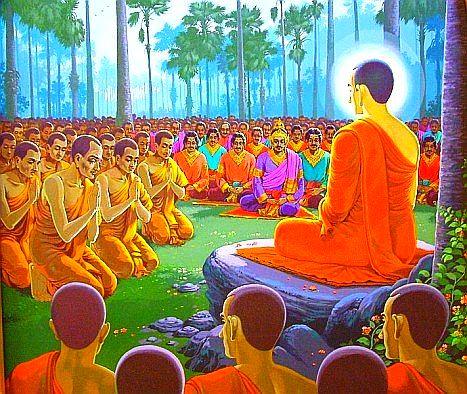
In wondering about all of the ways that we fool ourselves as we take things for granted, my curiosity often moves towards my own spiritual bypassing; around my periodic naiveté, and the way I take for granted all of the easy access I have had to the Dharma over the past fifteen years. I can acknowledge my hard work, my own personal insights and feel gratitude for my inner growth, but it is very humbling to notice how all of these wonderful sides of the spiritual path can be forgotten when I fall out of connection with others, or when I do not maintain a certain critical eye regarding my practice, or when I shy away from difficulty with unconscious ease. I’m sure that many readers can identify with some aspect of my experience, we have all done these things and it often goes unnoticed. When we apply the rosy light of spirituality to our behaviour that is rooted in hiding from others, hiding from our pain, and retreating into separation, we can very easily find wonderful defenses, wonderful ways to support us in not growing, in not changing (which is what growth is), and with not experiencing pain- a profound impetus for, and perhaps symptom of, growth. Sometimes we take for granted that we know ourselves at all.
These days its possible to receive dozens of empowerments, many different specific instructions, meet with many different spiritual teachers, and read many books that in the past were kept concealed, hidden to be revealed at the right time for maximum effect in one’s spiritual practice. That’s a lot of stuff. It’s not all bad, but it also seems possible for one to inadvertently suffer from a form of “spiritual diabetes” for lack of a better term. We have so much. Need so much. Often, we want so much. Do all the extra things, the personal libraries of sutra and tantra, the mountains of blessed substances from our teachers, make our spirituality more honest, stronger, more humble? Does that make it better? Why do we need it?

In my own life, I know that when I am plagued by my feelings of inadequacy or lack, I sometimes think, “Hmm. Maybe I should go back to India. Maybe I should go see my lama and ask for a really wrathful practice to get rid of these feelings”. To get rid of these feelings. In essence to split with them, to create a subtle distinction between those hard feelings and what I have an idea about what I should be feeling. I’m sure that others can identify with the feelings behind this kind of thinking. It’s a form of running away, a way of not facing with what I am feeling right now, of not being with what is arising in the moment and trying to get to know what it means, to notice its origin, and it’s effect- of creating further duality. Where does my feeling of lack and inadequacy come from?
In the parlance of Chöd practice: can I let go of holding on to the demon of lack and inadequacy? Rather than go on pilgrimage somewhere to accumulate merit when we feel terrible, what if we went on pilgrimage with ourselves? Rather than hiding, or hoping that adding a new practice will solve our deeply rooted suffering, what if we stopped, and touched the earth, as the buddha did and experienced the torment, our maras, and begin to enter into relationship with them? What would happen if we stopped buying books for a while, stopped seeking out the next teaching, and really sat with what we have. I suspect that we would find that we are more full than we recognize at first glance- that we have all that we need already.

on making offerings to those who have passed: bearing witness to september 11th

It is not uncommon when I am working in the hospital for people to ask me why it is that they suffer. Why, for example, is their loved one dying? Why is their medical treatment not working as well as they would like? Why they have been put in this terrible position? How could any of this be possible?
These are all personal september 11ths. They are intense moments of tragedy and fear, of worlds (and lives) imploding, of being touched in a way in which life will never be the same.
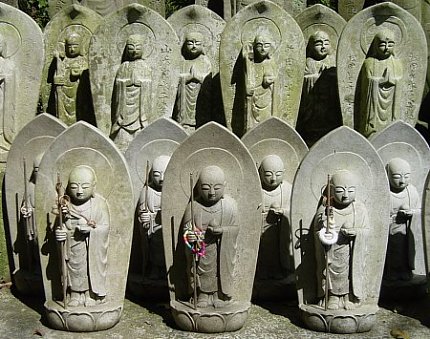
I was speaking with a friend recently about September 11th- she shared with me the fact that for her, the worst thing about September 11th was the sense of fear and uncertainty. Of course, the massive loss of life and the ripples of pain that were caused on that day is tragic and truly difficult to fathom, yet there is something of importance and meaning in my friend’s admission. September 11th created a sense of vulnerability and profound uncertainty. This uncertainty, and it’s attendant vulnerability, was so palpable and new that it seems to remain a confounding symbol of the fear, the shock, and the seemingly unreal nature of what occurred on that day.
Just as I cannot provide an answer to a patient who asks me why their cancer has metastasized, why a newborn baby dies, or why God created the depression or psychosis that a patient may experience and suffer from, I am not sure that we will ever know what September 11th means in an absolute and definitive way. The meaning of such difficult and painful experiences seem to change as we do. Indeed, perhaps the meaning is different from moment to moment- it may be that an absolute meaning is convenient in that it lets us off the hook from continuing to feel, and interact with, what arises.
In this spirit, I feel that spending a moment to consider what September 11th means for us right now can be of value. How does it sit with us now? How do we sit with it? What has our process of getting here been like? Can we let ourselves sit with whatever comes up, with whatever feelings arise?
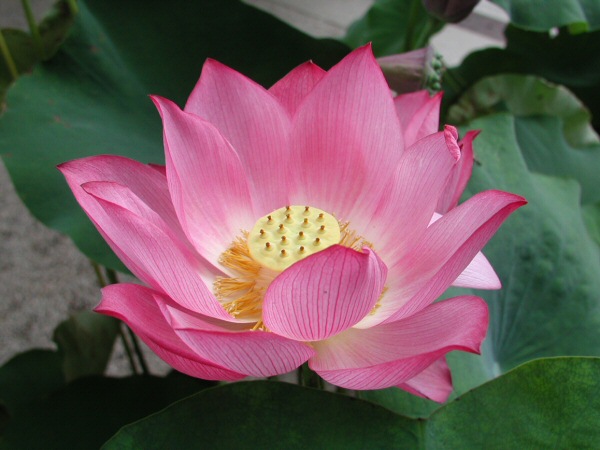

I would like to offer a prayer to Amitabha, written by the wonderful Karma Chagme (a 17th century Kagyu and Nyingma Buddhist master), for all of those who passed away on that terrible day, as well as for all of those who passed away afterwards, suffered afterwards, and to all who have suffered during the two wars that arose following September 11th. May they not be forgotten, may we remain witness to their stories, may their suffering be pacified, and may they experience expansive wholeness. May it be auspicious!
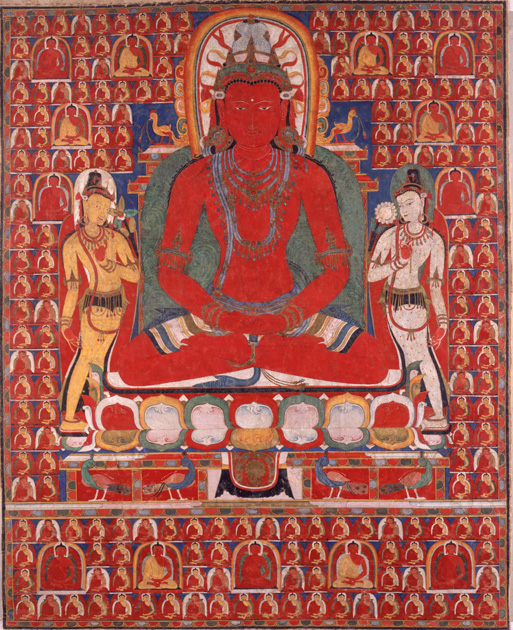
Prayer for Rebirth in Sukhavati – The Blissful Land of Amitabha Buddha
E ma Ho!
In the direction of the setting sun, beyond a multitude of innumerable worlds, slightly raised, is the perfectly pure realm of Sukhavati, a land of the noble beings. Although invisible to our fleshy eyes, Sukhavati can appear clearly within our mind. There resides the Subduer and Victorious One of Measureless Light, Amitabha, ruby red and with blazing radiance.
He is adorned with the ushnisha top knot on his head, the chakra wheels on his feet, and all the 32 signs of perfection and the 80 minor marks. He has a single face, two arms in the mudra of equanimity, holding an alms bowl, and wears the three dharma robes. He sits in vajra posture on a thousand petalled lotus and moon disc, with a bodhi tree to his back. From afar, he looks to us with eyes of compassion.
To his right is the Bodhisattva, Avalokiteshvara, white in colour, his left hand holding a white lotus. To his left is the Bodhisattva Vajrapani, blue in colour, his left hand holding a lotus marked with a vajra. They both extend their right hands towards us in the mudra of bestowing refuge.
These three main deities appear like Mount Meru, the king of mountains.
Radiant, pouring forth splendour and illuminating, – they dwell accompanied by their retinue of a thousand billion bodhisattva monks, all of whom are of golden colour, adorned with the marks and signs, wearing the three dharma robes, and of great resplendence. With devotion – free of discernment between near and far, – and through the 3 doors we prostrate with utmost respect.
From the right hand of the Dharmakaya Amitabha, of Limitless Radiance, Lord of the Buddha family, emanate light rays becoming Avalokiteshvara, and with a billion more emanations of the mighty Avalokiteshvara. From the left hand, emanate light rays that become Tara with a further billion emanations of Tara. From his heart, light radiates out manifesting as Padmasambhava together with a billion other emanations of Orgyen. We prostrate to you, Dharmakaya Measureless Light.
With the eyes of Buddha and throughout the six periods of the day and night, he constantly regards all sentient beings with love. His enlightened mind is ever aware of whatever thoughts and ideas arise in the minds of all sentient beings. He forever hears clearly and distinctly, whatever words are spoken by all sentient beings. We prostrate to the all-knowing Amitabha.
It is said that, – except for those who have abandoned the dharma, or committed the deeds of immediate retribution, – all who have faith in You and make wishing prayers to be born in Sukhavati; their prayers will be fulfilled: you will come to us in the bardo, and guide us into this land. We prostrate to you – the guide Amitabha.
To you whose life spans countless kalpas, who resides here without passing beyond suffering; to you we pray with one pointed respect, as is said that, apart from specific karmic ripening, and with the averting of all kinds of untimely death, so our life may last one hundred years. We prostrate to protector Amitayus.
It is said to join the palms with faith on hearing the name of Amitabha and about Dewachen is of greater merit than offering countless three thousandfold universes pervaded with jewels as gifts. And so with respect we prostrate to Amitabha, Measureless Light.
All who hear the name of Amitabha and develop true faith from the depths of their heart, just once, will never leave the path to enlightenment. We prostrate to the protector Amitabha of Measureless Light.
From the time of hearing the name of Buddha Amitabha until obtaining Enlightenment, we are freed of lower rebirths, only taking birth in a good family and having pure conduct in all lives to come. We prostrate to Amitabha, Boundless Light of bliss.
Our bodies and all our possessions, together with our roots of virtue, whatever offerings that are actually present or conceived in mind including the auspicious substances, the eight auspicious signs, the seven precious objects, all offerings within all time: billions of the three thousand fold universes with the central mountain, four continents, the sun and moon, the wealth of gods, nagas and humans – all this arising in our mind – and by offering to you, Amitabha, may we benefit through the power of your compassion.
We lay open and confess all the non-virtuous deeds which have been committed from beginningless time up to now, by ourselves – by all sentient beings, headed by our fathers and mothers. Through time without beginning, we and all beings, especially our mothers and fathers, now acknowledge and regret our wrongs:
We regret and confess the three physical non-virtuous actions, those of killing, stealing and impure conduct.
We acknowledge and confess the four verbal non-virtuous actions: lying, slandering, harsh words, and loose talk.
We confess with remorse the three non-virtuous actions of mind: covetousness, malice, and erroneous views.
We confess with regret committing and accumulating the five immeasurably evil deeds of killing our father, our mother, our teacher, an arhat, and intending to harm the body of a Victorious One.
We admit and confess the evil deeds similar to these immeasurably evil deeds: killing a fully ordained monk or a novice, causing a nun to fall, destroying a statue, stupa or temple, and the like.
We openly confess the evil acts of abandoning the dharma, like abandoning the three supports: the Three Jewels, temples, and the Holy Scriptures, blaspheming and such similar deeds.
We confess with deep regret all these extremely negative and meaningless actions like abusing bodhisattvas – an evil greater than killing all sentient beings of the three world spheres.
We confess with remorse, all previous disbelief on hearing of the benefits that virtue produces, and how evil deeds bring one the intense sufferings of hell,– this making liberation so difficult to attain, and so is worse than the five immeasurably evil deeds.
We confess and lay bare all falls and infringements of the discipline of individual liberation including the five kinds of faults: the four root downfalls, the thirteen remainder downfalls, the transgressions, the defeats, the individually confessed damages, and the faults.
We openly declare with sorrow all the transgressions against the developing of bodhicitta: the four negative dharmas and the fifty eight downfalls.
We confess with deep remorse spoiling the samaya of the secret mantra: transgressions of the 14 root downfalls and the 8 branch vows.
We admit and confess the non-virtuous deeds gathered by not requesting vows, impure conduct, taking intoxicants and the like, indeed all harmful actions which I was not aware of and unable to voice.
We regret and confess any and all of the transgressions and downfalls of the vows of refuge, empowerments and so on that we received, – with or without knowing how to keep the respective samaya commitments.
Since confession without regret will not fully purify, we confess our previous harmful deeds with deep remorse and shame, with the fear as if our bodies were filled with poison. By not keeping to our vows from now on, there will be no purification. So, even at the cost of our life, we must now determine to refrain from all further non-virtuous actions. Through the blessings of the Sugata Amitabha and all his heirs, may our mind streams be completely cleansed.
When hearing about others who have accomplished wholesome acts, may we abandon all unwholesome thoughts of jealousy and rejoice in their virtuous deeds with heartfelt joy, so accumulating merit equalling theirs, as it is said.
For this reason, let us rejoice in whatever virtuous deeds are accomplished by both realised and ordinary beings.
We also may rejoice in the vast activity accomplished by developing the mind of supreme and unsurpassed enlightenment for the benefit of all.
Let us rejoice in abandoning the ten unwholesome deeds and performing the ten wholesome acts: protecting others’ lives; making offerings; keeping our vows; speaking the truth, reconciling adversaries; speaking calmly, gently and sincerely; maintaining meaningful conversations; reducing desires; developing loving kindness with compassion; and practising the Dharma with understanding – in all these virtuous acts we rejoice.
Let us exhort all the perfect Buddhas, dwelling in all the myriads of worlds of the ten directions, to quickly and extensively turn the wheel of dharma right away. Please hear our prayers through the power of your perception.
We entreat all the Buddhas, bodhisattvas, holders of the dharma, and spiritual friends who are planning to enter nirvana, to remain here and not pass beyond suffering.
May we appropriately dedicate all virtue of the three times to be of benefit to all sentient beings.
May all of us quickly obtain unsurpassable enlightenment and stir the three realms of samsara from their depth.
May these virtuous actions quickly ripen for us and so pacify the eighteen causes of untimely death in this life.
May our bodies be free from illness and blossoming with the vitality of youth.
May our material wealth ever increase as the Ganges in the monsoon.
May we practise the sacred dharma free from the dangers of demons or enemies.
May all wishes in accordance with the dharma be fulfilled.
May we accomplish great benefits for the Doctrine and for beings.
May we make this human existence meaningful.
At the moment when we, and all who have connections with us, pass beyond this life, may emanations of Buddha Amitabha surrounded by his sangha monks actually appear before us.
On seeing him, may our minds be happy and joyful, – free from the sufferings of death.
Through their miraculous powers, may the eight bodhisattva brothers appear in the sky to guide us and show the path to Dewachen.
The torment in the lower realms is unbearable; the happiness and joy of gods and humans is impermanent – may our minds develop a fear of this. May we be concerned about the enduring nature of beginningless samsara.
If we are born as humans again, still countless are our experiences of birth, old age, sickness and death.
In this difficult and degenerating time when obstacles abound, the happiness of humans and gods is like eating poisonous food, may we abandon even our tiniest desires.
Relatives, food, wealth and friends are but like a dream, impermanent – illusory. May we be free from even the slightest of desire and clinging.
May we recognize countries, places and dwellings as unreal – like a ghost town in a dream.
May we escape from the ocean of samsara – like convicts released from prison without even a backward glance – and attain to the pure realm of Dewachen.
May we cut all ties of attachment and desire, and like a vulture released from a net, may we traverse innumerable universes to the West and at once reach the pure realm of Dewachen.
May we see the face of Amitabha Buddha and, in his presence there, purify all our veils.
May we take miraculous birth within the heart of a lotus blossom, the supreme of the four modes.
So may we instantly attain a perfect form complete with all the marks and signs.
Those, who have doubt of being born there, will remain five hundred years, happy and joyfully contented within the unopened blossom, still hearing the words of the Buddha though not seeing his face. May we be free from this uncertainty. May the lotus flower open so that we see the face of Amitabha as we are born.
Through the force of our virtue and refined powers, may we emanate inconceivable clouds of offerings through the palms of our hands as offerings to the Buddha and those attending.
May the Tathagata at that moment place his right hand on our heads and bestow prophecy of enlightenment.
On listening to the profound and expansive Dharma, may our minds ripen and so be liberated.
May the principal bodhisattvas, Avalokiteshvara and Vajrapani, bless and guide us.
With every day, as myriad buddhas and bodhisattvas of the ten directions come to make offerings and behold Amitabha and his pure realm, so may we at that time offer reverence to them and attain the nectar of the dharma.
Through our infinite miraculous powers, may we in the morning go to the sphere of True Happiness, to the Glorious Land, to the realms of Perfected Activity and Abundant Array. On offering profusely to the Buddhas Akshobya, Ratnasambhava, Amoghasiddhi, Vairocana and more, may we request empowerments, blessings and vows. Then may we return effortlessly to Sukhavati in the evening.
May we travel to the Potala, Alakavati, Kurava, Orgyen and the billion fold pure realms of Avalokiteshvara, Tara, Vajrapani, Padmasambhava and the billions of pure emanations. Once there, may we make oceans of offerings and request empowerments and profound essential instructions. So may we return swiftly and freely to our own places within Sukhavati.
May we guard, protect and impart blessings to our previous friends, monks, students and others, clearly seeing them with our celestial eye. May we thus, at their time of death, lead them to this land.
A single day within Sukhavati continues for the complete Fortunate Aeon in which we reside. May we remain in Sukhavati constant and free of dying for countless aeons. From Maitreya through to Möpa, may we see all the Buddhas of this Fortunate Aeon, as they appear in our world.
With magical powers, may we proceed there, make offerings to the buddhas and listening to the noble dharma. Finally, may we return unhindered to the pure land of Sukhavati.
May we be reborn in this especially sublime pure land of Sukhavati that manifests all the qualities of the buddha realms of myriads of buddhas.
May we be reborn in this gentle, peaceful land of bliss, where the ground is of jewel, even like the palm of one’s hand, vast, spacious, radiant and sparkling with light rays, cushioning pressure and then returning level.
May we be reborn in this wondrous land where wish fulfilling trees are arrayed with numerous gems, with leaves of finest silk and fruits as jewel ornaments. On them appear flocks of birds, harmoniously intoning and proclaiming the sounds of the profound and expansive dharma.
May we be reborn in this most astonishing of lands where the many rivers are of scented water with the eight pure qualities as is the water of nectar in the bathing pools. The surrounding stairs and ornaments are adorned with the seven kinds of jewels. Fragrant lotus blossoms bearing fruit are radiating innumerable light rays, the tips of which are adorned with emanations of the Buddha.
May we be reborn in this Land of Great Bliss, where talk of the eight adverse conditions or hell is never heard. Where no form of suffering is experienced, be it the three or five emotional poisons, physical or mental disease, enemies, poverty, discord, and the like.
May we be reborn in this land of boundless pure qualities where, not having lower forms or births from a womb, all are born from lotus flowers. All bodies are of golden colour and equally endowed with the excellent marks and signs, like the ushnisha, and so on; all possessing the five precognitions and the five clairvoyances.
May we be reborn in this realm of all arising bliss and joy; where bejewelled celestial palaces appear of themselves; where enjoyments effortlessly arise at their very thought, and all ones needs are spontaneously fulfilled; where cherishing a self and differences of you or I no longer exist. All wishes arise as offering clouds from the palms of one’s hand, and everyone practices in accordance to the dharma of the unsurpassable Mahayana.
Fragrant breezes bring great showers of flowers, and heaps of offering clouds of pleasing forms, sounds, fragrances, tastes and touches – all that one may enjoy arises from the trees, rivers and lotus flowers. With concepts free of femininity, hosts of goddesses appear. These offering goddesses of various forms forever present offerings.
Jewel palaces arise through ones mere wish to rest; and on wishing to sleep, there appear magnificent jewel thrones adorned with various cushions and pillows of delicate silk, surrounded with birds and wish fulfilling trees, rivers, music, and more. At ones wish, the sound of Dharma resounds; when one no longer wishes to hear, there is silence. As for the soothing bathing pools and streams, they become hot or cold to ones wishes. May we be reborn in this realm of accomplishing all wishes.
The perfect buddha Amitabha will remain in this pure land for myriads of aeons, before passing into Nirvana. May we serve him until then. On passing into peace his teaching will remain for aeons as numerous as the grains of sand in two Ganges rivers. At that time may we uphold the noble dharma, not being separated from his regent Avalokiteshvara.
As the sun of the dharma sets in the West, so will manifest the dawn of the enlightenment of Avalokiteshvara. Renowned as “the Buddha, the utterly sublime sovereign, glorious and radiant”, may we behold him, make offerings and listen to the noble dharma.
For the sixty-six trillions of myriad aeons that he manifests, may we continue to serve and venerate him; and ever mindful, may we maintain the holy dharma.
After his passing into nirvana, his teaching will remain for thrice six billions of myriad aeons. For all this time, may we maintain the dharma and be inseparable from Vajrapani. With life span and teaching equalling Avalokiteshvara, so shall Vajrapani become the buddha “The utterly stable Tathagata, Sovereign with arrays of precious good qualities”. May we present our offerings and serve this Buddha continuously by upholding all the noble dharma.
When one’s life is over, at that moment may we obtain unsurpassed perfect Enlightenment in this pure land or in another pure realm.
On the attainment of perfect Buddhahood and in the same way as Amitayus, may all beings be ripened and liberated through the hearing of our name. With limitless skill and countless emanations, may we guide sentient beings, spontaneously accomplishing their welfare.
The life span of the buddha, his virtue and qualities, his pristine awareness, his splendour are infinite. So is it said that whoever recalls the names – Amitabha Dharmakaya of Boundless Brilliance, Immeasurable Radiance, or Amitayus Lord of Immeasurable Life and Primordial Wisdom – will be protected from all dangers of fire, water, poisons, weapons, harmful and demonic forces, and more besides, the only exception being fully ripened previous karma.
We prostrate and beseech you by name, protect us from all fear and suffering and grant your blessing of abundance and auspiciousness.
Through the blessing of attaining to the three bodies of the Buddha, through the blessing of the truth of unchanging dharmata, and through the blessing of the unceasing aspirations of the sangha, may all our prayers be also accomplished.
We prostrate to the Three Jewels. Teyata Pentsan Driya Awa Bhodhanaye Soha.
We prostrate to the three jewels. Namo Manjushriye. Namo Sushriye. Namo Utama Shriye Soha.
This prayer was composed by the renowned buddhist teacher Karma Chagme. Since this original composition was drawn from the sutras of the Buddha Sakyamuni, no transmission for reading this prayer is required.
[This rough translation to English of this magnificent prayer is offered as a basis for others to read, take to heart, copy and distribute with their glorious intention to benefit others; and specifically that all – wishing to make connections to buddha Amitabha and aspiring to be reborn in Sukhavati – may make the efforts to gather the 4 causes and so reap the experience and joy of rebirth in this wondrous land of bliss. With apologies for imperfections! Karma Zhisil Drayang.]
on maintaining confidence in our emerging buddha nature…
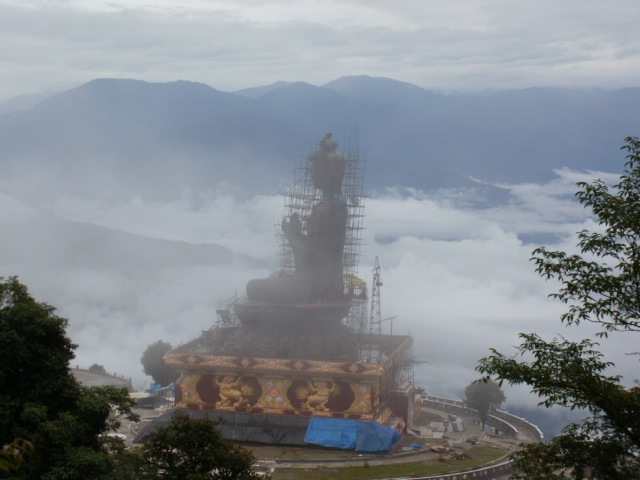
I recently returned from a period of retreat and instruction with His Eminence Gyaltsab Rinpoche, regent of the Karma Kagyu lineage. I consider myself fortunate to have had the opportunity to continue to spend time at his monastery- Palchen Chosling-in Sikkim and to receive precious guidance from him. While at Palchen Chosling, His Eminence also empowered me as a repa; a tantric yogin following in the foot steps of Mila Shepa Dorje (Jetsun Milarepa)- I am profoundly grateful and moved by Rinpoche’s kindness in offering me the chance to follow this particular path. I also am also curious as to how I can bring this experience to the people who I visit at the hospital (and everywhere else).
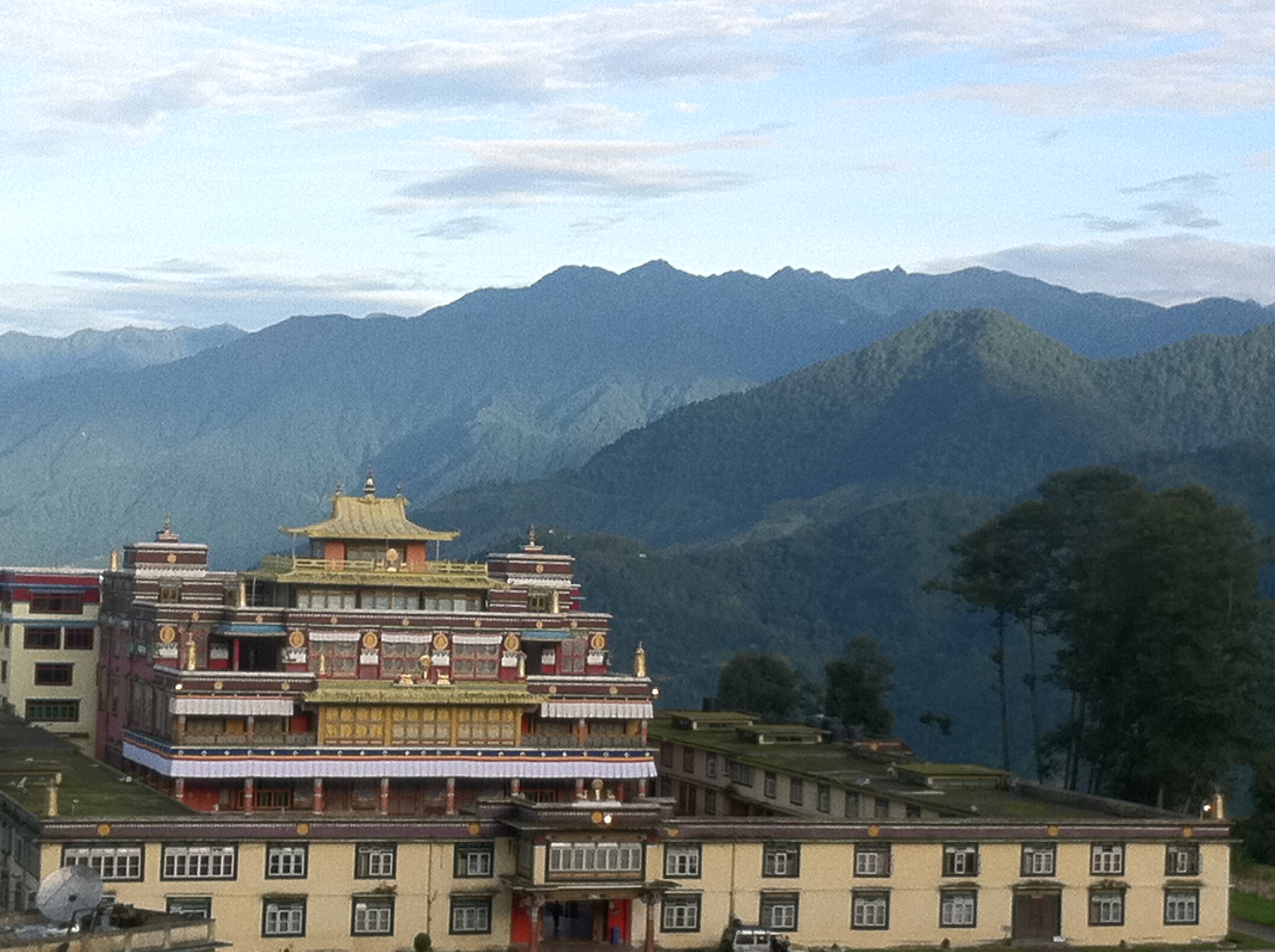
During my stay at Palchen Chosling, a few threads of thought wove themselves throughout my experience of the breaks between meditation sessions, while wandering the mountain roads down to Old Ralang monastery, Karma Rabten Ling, which was founded under the guidance of the 12th Karmapa, Changchub Dorje, and at various other points throughout the day. These contemplations are something that I would like to share with you, as they brought some meaning for me, reinforcing a sense of wonder and awe surrounding spiritual practice.
There was a moment while His Eminence was teaching when I was struck by the power of the lineage teachings. In that moment their efficacy felt particularly potent, as did the enduring effect of the power of the single pointed application of the teachings by a number of past lineage holders as well hitherto unknown practitioners. It felt as if I could easily connect with those who had gone before me, and that their presence, or perhaps their residual blessings remained for anyone to feel who treads the shared path. I felt that there must be hundreds of practitioners who experienced awakening for every one who became well known- indeed, I suspect that perhaps more people than we know have derived great benefit from the practice of such liberating instructions.
Inspired in this way, I kept coming back to wondering about Dusum Khyenpa, the first Karmapa. I wondered about the rich and full life of practice that he lived, and the wide range of emotions that he brought to his experience of the dharma. His pain and jealousy, which at times was murderous seem so common, so ordinary, that they are very easy to identify with. From these common emotional roots Dusum Khyenpa fully integrated the teachings presented by both Gampopa as well as Rechungpa. To this end, as an indication of the clarity and depth of his experience, Dusum Khyenpa reappeared after his death in the form of Karma Pakshi, the second Karmapa, thus beginning the first and oldest established reincarnation lineage found anywhere in Tibetan Buddhism.
Karma Pakshi was a great mahasiddha. His intensity and great spiritual abilities in many ways appear to be a natural result of the depth of the effort as well as the unique blessings of the Karma Kagyu dharma. It makes sense that he arose after Dusum Khyenpa passed away; it seems that arising in the form of Karma Pakshi expressed the true nature of the activity of Dusum Khyenpa. In reflecting upon this, I have been reminded of how it is said that from time to time within our practice it is possible to begin to traverse the bhumis, and yet not manifest all of the signs that indicate our awakening until we have died and take up our new Nirmanakya “form”- perhaps this is the case with Dusum Khyenpa and Karma Pakshi.
I was left to wonder, or perhaps return to, a very old question: Is the liberation expressed by Dusum Khyenpa a result of his already being a great being capable of more than most of us? Or, is his liberation a result of the efficacy of the dharma when put into practice with all of our heart?
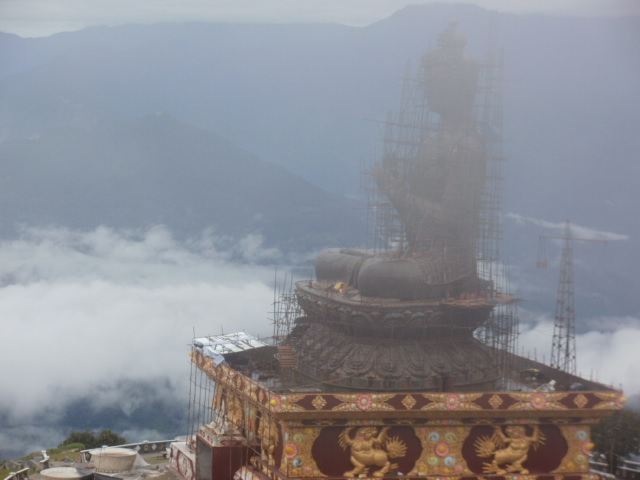
My intuitive reaction to the power of His Eminence’s teaching left me to feel that this dharma, imbued with the still-fresh warm breath of the dakinis, has an ability to completely change our experience of reality. Certainly, one cannot remove or even separate the blessings of all of the great masters of the past who have held any given lineage of instructions we receive. They have left their mark, imbuing the dharma with their particular seal, something that we can interact with centuries later. Indeed, it is often written that connecting with the blessings of this lineage is part of the power of the experience, a fundamental ground upon which realization may dawn. Asking these kinds of questions help us to truly recognize the powerful nature of dharma. Such questions impact the way we frame our own potential; the way we allow ourselves to define the possibilities of our own enlightenment; they are clear illustrations of just what we will permit ourselves to do. These questions are natural, but great care should be given in answering them- there is always a chance that we may undercut ourselves and cease to allow ourselves to mutually let the dharma sink into our experience of life while simultaneously letting ourselves sink into the dharma, thereby letting experiences arise naturally. If we don’t allow ourselves to fully blend with the dharma and arise within it awakened within ourselves what is the point of taking great care in applying the dharma to our lives?
Wondering whether great masters are special beings- essentially separate from you and I, or whether they simply allowed themselves to rely upon and integrate the dharma in their own individual way, unique and appropriate to their perceptual matrix, and that in so doing, came to illustrate the power of the dharma, has gone on for centuries. It is a meaningful subject of contemplation. Such reflections not only figure largely within the namthar- or liberation story- of Jetsun Milarepa, but was a point of controversy within the composition, collation and dissemination of the numerous versions of his namthar between the 13th and 18th centuries.
Dr. Peter Alan Roberts’ The Biographies of Rechungpa: The evolution of a Tibetan hagiography, offers a wonderful description of the many existent biographies of Milarepa as well as a very compelling analysis of the evolution of Milarepa’s biography. As one would expect, while there is a shared narrative between most of these biographies, there is a range of focus upon particular aspects of the life of Shepa Dorje. Indeed, anyone with even a small interest in hermeneutics will recognize that what is really known of the life of Jetsun Milarepa is, and has been, open to much interpretation. Such is also the case with the often over simplified polarized roles of Jey Gampopa (monk) and Rechungpa Dorje Drak (yogin), the two most well-regarded disciples of Milarepa. To truly asses their exact nature historically is much like trying to ascertain the actual distinctive differences between Jesus’ disciples- no small feat! And yet, despite the fact that nearly a millenia has passed since the time of Jey Milarepa we do have some idea as to who he was and what he embodied.

Roberts’ work opens up a lot of places for creative enquiry not only around the life of Milarepa and Rechungpa, but of the re-telling of the Kagyu story from the prevailing monastic perspective. Related subjects also include what I would call the “cross-over” issues that faced tantric Buddhism as it became ensconced within a monastic setting; some of the questions around these topics continue to this day. Many of the questions that arise from his work seem especially important to ask oneself as one treads the path of the Kagyu lineage in general. It appears that through asking such questions we open ourselves to gaining greater certainty for ourselves as to how, and in what way, we want to relate not only to the transmission lineage of our practice, but also the essential embodiment uniquely expressed by each lineage master.
Apparently, in most of the collections of the life of Milarepa, he is described as an emanation of Manjusrimitra– an important early lineage holder of dzogchen practice. This view was suggested as early as the 14th century in the work of as yet determined authorship entitled The Life and Songs of Shepa Dorje, the best known collection of Milarepa’s songs before Tsangnyon Heruka‘s Hundred Thousand Songs of Milarepa. This view was supported by Kachö Wangpo, Jamgon Kongtrul Lodro Thaye as well as Ngari Terton Dawa Gyaltsen. The general view of Milarepa as an emanation is first known to be maintained by Gampopa, and is then supported by Lama Shang and Donmo Ripa. In Tsangnyon Heruka’s biography of Milarepa, which in translation has become the singular source of the details of the life of Milarepa, we find a dramatic departure from the view expressed by these past masters: Milarepa is portrayed as a normal sentient being!

In the Lhalungpa translation of Tsangnyon Heruka’s biography of Milarepa, towards the end of the story there is a scene where Milarepa is surrounded by his students after it is known that he will soon die. In a moment of sadness, and perhaps even desperation for final instructions, several questions are asked of Milarepa as to whom he is the reincarnation of as someone as exemplary as Milarepa could not possibly be “ordinary”. This is what is presented:
“Then Bodhi Raja of Ngandzong asked:
‘Lama Rinpoche, it seems to me that you are either the incarnation of Vajradhara Buddha and that you engage in all these actions for the benefit of sentient beings, or you are a great Bodhisattva who has attained the state of “Non-returning” and who has accumulated immense merit for many aeons. In you, I see all the characteristics of a true yogin who sacrifices his life for the Dharma practice. We humans cannot even conceive the extent of your asceticism and your devotion to your lama, let alone practice it ourselves. If we dared to practice in this way, our bodies could not bear such an ordeal. That is why it is certain that you were a Buddha or Bodhisattva from the very beginning. And so, although I am incapable of religion, I believe that we sentient beings will be led toward liberation from samsara through seeing your face and hearing your words. Revered Master, I be you to tell us if you are the incarnation of a Buddha or a Bodhisattva.
‘The Master replied:
‘I never heard whose reincarnation I am. Maybe I am the reincarnation of a being from the three lower realms, but if you see me as a Buddha you will receive his blessing by virtue of your faith. Although this belief that I am an incarnation springs from your devotion to me, actually there is no greater impediment to your practice. It is a distortion of the true Dharma. The fault lies not in recognizing the true nature of the achievement of great yogins. The Dharma is so effective that even a great sinner like myself has reached a stage not far from Enlightenment due to my own belief in karma, my subsequent renunciation of the aims of worldly life, and due especially to my single-minded devotion to meditation.
More particularly, if you receive initiation and the secret instruction which brings spontaneous awakening included by conceptualizations, and if you then meditate under the guidance of an enlightened lama, you will undoubtedly attain Enlightenment.”
Milarepa is incredibly clear: Although this belief that I am an incarnation springs from your devotion to me, actually there is no greater impediment to your practice. It is a distortion of the true Dharma. The fault lies not in recognizing the true nature of the achievement of great yogins. He goes on to further stress the importance of contemplating impermanence, karma, and the development of renunciation towards worldly dharmas along with the importance of applying great effort in the practice of meditation. This is his path, the way in which he expresses his practice: great simplicity.
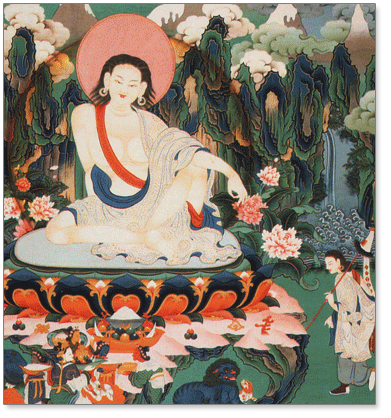
Why do we tend to ask questions like the one offered by Bodhi Raja of Ngandzong? Or maybe the better question is: what happens when we don’t ask whether or not we can fully express our infinite potential, and just let ourselves grow and change the way that we will? What happens if we apply the essential instructions that clarify our understanding and relationship with our mind, placing special care to also apply such instructions to our expectations towards our potential, towards the ideas of progress, even time, or the notion of physical place?
A great example of such instructions are Tilopa’s six methods for maintaining the absorptive state, or his Six Nails of Key Points:
Let go of what has passed.
Let go of what may arise.
Let go of what is happening now.
Let go of modulating (examining).
Let go of trying to control (there is nothing to do).
Let the mind rest in its natural state.
When we consider where “we” are in relationship to time, to location, and to general appearance, in a genuine heartfelt way, our inner scaffolding, the need for support, and the gentle movement of our clouds of doubt and subtle obscuration begins to dissipate. The rays of our natural light shines- the question of when, where, how and why lose imminence; they are answered with a silent knowing, and inner surety. Might this be what liberated Milarepa? Perhaps this is the achievement of great yogins to which Milarepa refers.

While these rays, innate representations of our stainless purity, our undeniable inheritance, an immovable storehouse of blessings, empowerment and transmission, are known and experienced at times in a way that might initially appear shaky and tentative, it is important to remember that our provenance, the nature of our core-being, is that very stainless purity.
The martial and strong-willed Lama Shang (of whom you can learn more here), a student of Gampopa and founder of the Tsalpa Kagyu writes:
Upon loosening mental consciousness through relaxation
Inner sensation and clarity of non-discrimination emerge like the expanse of the clear sky.
This represents the clarity of dharmakaya.
Similarly, one can find many passages that help to illustrate the mind’s essential nature, the way through which we can recognize with constancy the way the mind arises, and that this buddha-like essence is always here, we simply fail to recognize it. These pithy instructions are often essential in nature; short and sweet, relaxed and expansive.

Tibet in the 15th century bore witness to a tremendous amount of spiritual distillation and passionate vigor that lead to a structuralism that allowed for the foundation of the Geluk lineage and the subsequent philosophical and scholastic discourse. It was also a period that witnessed the rise of teachers like Tsangnyon Heruka, Drukpa Kunley and Thangtong Gyalpo, all of whom sought to laugh in the face of convention; for them the central loci of dharma was the authentic practice of dharma, where an atmosphere of iconoclasm and openness tempered by rigorous personal dedication to samaya and the stream of essence dharma was of prime importance.
I am captivated with a giddy curiosity around what it means to bring this spirit of free enquiry, of dedicated vision, and the certainty needed to abandon some of the heavy dead weight that accompanies our practice. Can we apply the leaches of pure vision to the engorged stagnant well fattened body of our assumptions and dull fundamentalism so that the blood of heavy density is removed? Can we allow ourselves to embrace siddhas, or complete madmen, like Tsangnyon Heruka and Thangtong Gyalpo in our conception of “practice”? How do we add the rowdy passion and the complete assembly of the ganachakra to the steady perhaps overly controlled conception of how the middle way appears? Can we embrace the full luminosity of mind? When does the structure of our spiritual path get in the way? How do we defer to the structure rather than letting ourselves begin to walk?
The slight change in perspective that Tsangnyon Heruka offers us in his Life of Milarepa, through his suggesting that we may all achieve complete enlightenment by the power of the dharma blended with our own effort is a gift. It allows all of us to assume a seat in the larger ganachakra of buddha-beings, to gain access to our true inheritance as the young Milarepa did, and to transcend the death blows that our inner tendencies towards the distancing aspects of philosophy and rationalism (perhaps represented by Geshe Tsakpuhwa, the one who poisoned Milarepa). Thus freed, we are able to experience all that he has experienced; we are free to know that our practice can ascend to great heights; we are free to know that this buddha nature of ours will naturally dawn.


![[Valid RSS]](valid-rss-rogers.png "Validate my RSS feed")
 Ganachakra